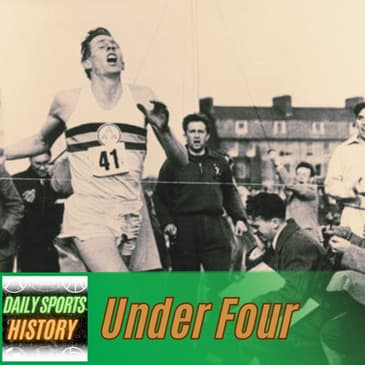
Discover the riveting tale of Bannister's quest to conquer the four-minute mile, from the relentless training regimen to the fateful race day at Oxford's Iffley Road Track. Hear tales of perseverance, triumph, and the indomitable human spirit as Bannister crossed the finish line in a feat that captivated the world.
Through concise storytelling, we celebrate Roger Bannister's historic achievement as a testament to the power of human potential and the relentless pursuit of excellence.
Website: dailysportshistory.com
Email: dailysportshistory@gmail.com
YouTube: YouTube.com/@dailysportshistory
Twitter: twitter.com/dailysportshis
Facebook: facebook.com/profile.php?id=61551687917253&mibextid=ZbWKwL
Tiktok: tiktok.com/@daily.sports.history?_t=8hHPnNSCqfm&_r=1
#RogerBannister #FourMinuteMile #RunningHistory #AthleticAchievement #SportsLegends #TrackAndField #Mile #running
Buy me a coffee: buymeacoffee.com/dailysportz
Newsletter: https://substack.com/@dailysportshistory?r=3en496&utm_medium=ios&utm_source=stories&shareImageVariant=light
DailySportsHistory.com
Email: dailysportshistory@gmail.com
YouTube: YouTube.com/@dailysportshistory
Twitter: twitter.com/dailysportshis
Facebook: facebook.com/profile.php?id=61551687917253&mibextid=ZbWKwL
On May sixth, nineteen fifty four, a British athlete named Roger Banister does something no one on earth has ever done before, and something many thought was impossible. He ran a mile in under four minutes. And the day we're going to dive into how he did this on Daily Sports History. Welcome to Daily Sports History. I'm Ethan Reese, your guide to a rapid deep dive into sports history every day now. We really didn't start keeping track of the mile time until the IWF started keeping track of track and field records in nineteen thirteen, and at that time the best record for the mile run was four minutes in fourteen seconds, but records do go as far back as eighteen eighty five, where then record was four minutes and twenty eight seconds, And every year we inched closer to running a mile and under four minutes, but it was slow burn and in nineteen forty five Gunther Hag who ran four minutes in one second, which is one of the reasons Roger Banister took to running. He was inspired by countryman Sidney Woodson, who made a comeback to compete with guter Hag, and despite losing, he still set the British record at four minutes four seconds. Now, Banister had always been a runner, but this is when he really took it seriously. And the next year, in nineteen forty six, he started at Oxford as a student and joined their track team, and he showed promise right away. He had never worn running spikes on a track before, and after three weeks over it is time to four minutes and twenty four seconds, and the team let him know that he had a chance to make the Olympics with that time in nineteen forty eight, which were actually being held in England, but he didn't feel ready to compete as he was still going to school and wanted to focus on his studies, and he continued to train but would not attempt an Olympic run, and in nineteen fifty, while still at Oxford studying medicine, he continued to train and at the European Championships that August, he competed in the eight hundred meter as well as the mile, running the eight hundred meter in one minute fifty seconds and his mile was four minutes and thirteen seconds, finishing in third place in both events, and Banister was tired of not winning and he decided to devote more time to running. In the following year, at the Triple A Championships, he finally won the mile race with a run of four minutes and seven seconds, stuttying the record for the meet, facing the best competition he had faced so far, and now he was getting serious and wanted to attempt to join the nineteen fifty two Olympics, even though he was still in medical school. He knew his time to be able to compete in the Olympics was limited and this may be the last time, and in nineteen fifty one he avoided as many races as he could and didn't start training until nineteen fifty two to save his energy for the Olympics. At the trials for the Olympics, he ran the eight hundred meter at one minute fifty three seconds, Then he ran the mile at four minutes ten seconds and would skip all other competitions until the Olympics. In Helseki, Finland, ten days before the final of the Olympics, he did run a time trial of three of the four laps for the Olympics, coming in just under three minutes at two minutes and fifty two seconds, in which gave him confidence heading in to the finals, although in the semi finals at the fifteen hundred meter he finished fifth against all the other competition and almost missed the final round as he was the last competitor to qualify, but for the final on July twenty sixth, nineteen fifty two, was one of the great greatest finales in fifteen hundred meter history, where all four races finished within a meter of each other, but Josie Barthello of Luxembourg ended up setting the Olympic record and winning the gold with three minutes and forty five seconds, and the next three runners all broke the previous record as well, but Banister finished just outside the top three, breaking the record, but finished fourth, setting the British record at three minutes forty six seconds, and left the Olympics with no medals. Feeling defeated. After this moment, he set his sights on something that many thought was impossible. He wanted to break the four minute mile. He knew with his studies and his goal to become a doctor, he may never have a chance again to compete in the Olympics, but he knew he was one of the best runners in the world and wanted to prove that one good thing that happened at the Olympics. Banister realized that having someone to pace him made him a better runner, as he was a chasing runner. In nineteen fifty three, on May Seconds, he attempted to break the record, being paced by fellow colleague Chris Cattaway. Or was able to run four minutes in three seconds, shattering the British record, and Banister realized he had the chance to actually break the record if he continued to train. So after training for months and months, they set a date to attempt to break the four minute mile. It was at a race in nineteen fifty four where Oxford, based off against the Amateur Athletic Association, had a dirt track with his two pacers, Chris Cattaway and Chris Brasher, but the morning of was a rainy day. They weren't even sure the race could be run. It was not the conditions they wanted, but they had trained and set everything up for this moment, so they steed up to the starting line and Chris Basher takes the first two laps to pace Banister to attempt to break the record, and after the first two laps, Banister's time was one minute fifty eight seconds, right on track to break the four minute mile. Then Chris Chadaway takes over for the final two laps and the crowd starts to roar as the excitement is building for the chance to see history. Down the final straightaway, Banister takes off and gives everything he has and comes to the finish line and almost collapses on the ground if not for his team there to catch him. And it's almost silent as we hear the loud speaker announce the results of the race, saying the winner of the mile race is Banister with the time of three. In the moment he said three, the crowd erupted. No one heard hit. The rest of the time, it didn't matter because the moment they heard three meant he had broken the four minute milele, something that no one thought could ever be done before. In his official time was three minutes fifty nine seconds point zero four. But sadly this didn't last forever, as only a month later Australian runner John Landy ran three minutes in fifty seven seconds. But on August seventh that year, Banister would get a chance to race against John Landy and beat him with a time of three minutes fifty eight seconds, a race that was later to be known as the Merrek Mile as they saw two runners both run under four minutes. Not long after, Banister gave up running competitively and focus on practicing medicine in the field of neurology, which he would do for the next forty years. Later on, he would be knighted by the Queen and be known for the rest of his life as Sir Roger Banister and support the sport of running for the rest of his life even though he wasn't competing anymore. Despite never winning an Olympic medal, Roger did something many thought was impossible, and because of this, his name will always be remembered in the history books. Because sometimes the impossible just needs one person to stand up and show that it's possible. But what's not impossible is subscribing or following Daily Sports History so you don't miss an episode, Because the best thing you can do is to support us is come back and listen every single day, So don't miss another episode tomorrow of Daily Sports History.