Buy me a coffee: buymeacoffee.com/dailysportz
Newsletter: https://substack.com/@dailysportshistory?r=3en496&utm_medium=ios&utm_source=stories&shareImageVariant=light
DailySportsHistory.com
Email: dailysportshistory@gmail.com
YouTube: YouTube.com/@dailysportshistory
Twitter: twitter.com/dailysportshis
Facebook: facebook.com/profile.php?id=61551687917253&mibextid=ZbWKwL
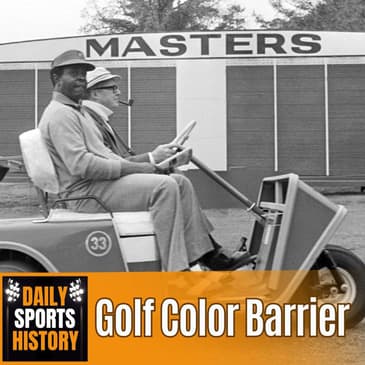
On April tenth, nineteen seventy five, was a moment that would change golf ever. At the nineteen seventy five Masters at Augusta National Golf Course, Lee Elder became the first African American to ever compete in the one of the most prestigious golf tournaments of all time. His journey to this game was a testament to resiliency and change. Not only was this a huge moment in equal rights in sports, but one of the most historic golf tournaments of all time. Today, we're going to discover how Lee Elder paved the way for generations to come by playing in just one golf tournament. Today on Daily Sports, Welcome to Daily Sports History. I'm Ethan Reese, your guide as you daily learn more about sports history, increasing your sports knowledge as we dive into Lee Elder playing in the nineteen seventy five Masters, and today's trivia question to listen out for is how much did Jack Nicholas win the nineteen seventy five Masters By listen throughout the episode to hear the answer, and if you miss it, I will give it to you at the very end. So first, let's go back to how the Masters actually got started. It all started at Augustal National Golf Course in nineteen thirty two when we cover this on a previous episode about the very first Masters tournament. And it was founded by legendary golfer Bobby Jones and some financial men who envisioned a world class winter golf course on a three hundred and sixty five acre site in Augusta, Georgia, which previously was a nursery and plantation called fruit Land, and it was designed to blend natural beauty and strategic challenges. And it opened with its first Master's tournament in nineteen thirty four, won by Horton Smith, although he didn't win the green jacket, and that tradition didn't start till after World War Two. But one thing that also came with this was exclusive membership. There was a no application process. You had to be invited to be a member, and even to this day, country clubs have a bad reputation about excluding certain people, whether to raise gender, sexual orientation, or they just don't like you. But the club ended up getting about three hundred members, including business leaders, cultural icons and world leaders like Dwight D. Eisenhower. But the fee to join was between two hundred and fifty and five hundred thousand dollars, which meant you were excluding many people to enjoy the game of golf at this exclusive club. But it also gave a mystique to this club and allowed it to maintain its higher echelon of exclusivity. It wasn't until nineteen ninety when the club first admitted its first African American member, and women were excluded till twenty twelve. These policies have sparked controversies throughout the years, and they're not the only golf course or country club to do this, and it takes people like Lee Elder to help break down these barriers because unless someone puts it in front of your face, sometimes it doesn't have staying power. So let's dive into who Lee Elder was, and he wasn't the very first African American golfer. Truthfully, that was John Sipin who was the first African American to play in a major golf tournament in eighteen ninety six, which known as the US Open back then, at just seventeen years old, and he was able to finish sixth, paving the way for future black golfers. But black golfers were often excluded by majority of major tournaments, so they founded the United Golf Association in nineteen twenty six, which helped make a platform for black golfers who were excluded from PGA events due to segregation and allowed them to showcase their talents, just like the Negro League in baseball allowed baseball players to showcase their talents when Major League Baseball would not allow them to play. And then entered Charlie Seifert, who's known as the Jackie Robinson of golf. He was the first African American to earn a PGA Tour card in nineteen sixty one. Yes, you heard that right. It wasn't until nineteen sixty one when an African American was allowed to play on the PGA Tour because the PGA Tour had a clause in their rules that said Caucasians only. It wasn't just white people. It was no Hispanics, no Asians, no African Americans, only whites till nineteen sixty one. And despite despite Charlie facing racism death threats, he was able to win multiple tournaments as multiple PGA tournaments, and in twenty fourteen he actually earned the presidential Medal of Freedom for the groundwork he paved in the golfing community. So Lee was born in nineteen thirty four in Dallas, Texas, and he had a rough go of it, losing both his parents by the age of nine, and he and his older brothers moved to Wichita Falls, Texas to live with their aunt, where he actually began to caddy at a local golf course to earn money, and this is where he learned to love the game and actually learn the craft. He taught himself golf by studying the swings of players that he was caddying for, learning how they played the game so he would know how to play it himself. He would practice using a single seven iron and created makeshift holes in a field nearby his house. Using his makeshift courses, he was able to hone his skills and at the age of fourteen, he was able to move to Los Angeles where he met Ted Rhodes, a pioneer in the African American golfing community, and he took Elder under his wing and taught him advanced techniques and exposed him to competitive play and allowed him to develop as a golfer. But like many young men in nineteen fifty nine, he joined the US Forces and joined the Army and played golf with his commanding officer at Fort Lewis in Washington State, which allowed him to hone his skills all the way until he was discharged from the army. And after leaving the Army, he joined the UGA. Which was a circuit which we've talked about, was the circuit for black golfers excluded from the PGA, and he won five of their national championships in twenty one out of twenty three tournaments during one stretch. Then in nineteen sixty seven, six years after PGA had lifted the ban of the Caucasian only clause, Elder was able to raise enough money to join the Qualifying School, which if you joined the Qualifying School, it's like a testing ground to show that you have the skills to join the PGA and allows you to compete in tournaments to access a PGA Tour card, which he was able to do in nineteen sixty eight. He did this despite many of the clubhouses that he would play at on the PGA Tour still excluded African Americans. But in that first year he tied Jack Nicholas and Frank Beard for the lead in the American Golf Classic before losing to Nicholas in a playoff, showcasing his skill was on par with one of the greatest golfers of all time. It took six years before he got his very first PGA win at the Monsau Open in Pensacola, Florida, the same course that he had once been denied to play previously due to his race, and this victory earned him a spot in the nineteen seventy five Masters, which made him the first African American to be invited to compete in the tournament. And this was a huge moment in league got so much attention from the media and racist people sending him death threats, causing him to hire security team and even rent multiple houses so they never knew where he was actually staying at. Down in Georgia. It was a tough time to be playing down South and many didn't want to see the color barrier in golf broken at all. And on top of that, he also was getting so much media ask him questions about golf or his life or the death threats that he couldn't even practice on his own. He had to go to the officials, say can't I have a press conference so they can ask on me these questions instead of coming onto the course, or I'm trying to practice to just allow him some sibilance of normalcy. Then he comes to April tenth, when he finally hits his opening tee shot, hitting a two hundred yard drive down the fairway, breaking decades, becoming one of the first African Americans to play this course ever in the first in the Master's tournament. In his first round saw some positives where he had a birdie on a par five and some other bogies, but he really played a solid round overall, hitting a plus two seventy four opening round and having him just seven shots behind the leader at the time, Bobby Nichols. But the second round had some adverse weather conditions where it was super windy and he couldn't keep up and shot a disappointing six over seventy eight, missing the cut by four strokes. And the cut is when they trimmed down the field so that the final rounds of the tournament in the PGA, so the people attending, he really focused on the leader board and afterwards though Lee was quite positive. He said that he got to enjoy Augustu's flowers and trees and saying he had struggles keeping the ball on the fairway being the rough and the foliage, but it was something he said that he was all over the place, but he was glad he got to play and unfortunately missing out on what was to come, which was one of the greatest endings to a Master's where Jack Nicholas, Johnny Miller, and Tom Wiskoff all came into the final round battling and it came down to a one stroke win where Jack Nicholas shot a negative twelve, beating the other two by one stroke, winning his fifth Master's title getting another green jacket. But this was a huge moment for golf as Lee became a role model for many golfers to come and actually, when Tiger Woods won his very first Masters back in nineteen ninety seven, Lee was there to help congratulate him, and Tiger references Lee as one of his mentors and one of his role models that led him into the game. According to recent stats, roughly three percent of recreational golf in less than two percent of professional golf players are black, so it still shows that golf has not changed a lot, but that number was so much lower, and it has allowed for other ethnic groups to join in as it's been a barrier that has less but it's still there because it's a huge barrier to just play golf on a regular course as it's a huge financial burden and it's just look and it's a challenge to learn how to play, which has excluded many many possible players. It's a slow burn. Go remember it was centuries of segregation that led to this and takes a long time to knock that down. I want to thank you for listening to Today's Daily Sports History and if you like this, please make sure you follow or subscribe wherever you're listening. That way you do not miss another episode and we will see you back again on Monday. And did you catch the answer to today's trivic question how much did Jack Nicholas win the nineteen seventy five Masters by? And the answer is he came back to win the Masters by just one stroke, shooting twelve under for the tournament. Tempo Priman ten Briton tempor