Website: dailysportshistory.com
Email: dailysportshistory@gmail.com
YouTube: YouTube.com/@dailysportshistory
Twitter: twitter.com/dailysportshis
Facebook: facebook.com/profile.php?id=61551687917253&mibextid=ZbWKwL
Tiktok: tiktok.com/@daily.sports.history?_t=8hHPnNSCqfm&_r=1
Buy me a coffee: buymeacoffee.com/dailysportz
Newsletter: https://substack.com/@dailysportshistory?r=3en496&utm_medium=ios&utm_source=stories&shareImageVariant=light
DailySportsHistory.com
Email: dailysportshistory@gmail.com
YouTube: YouTube.com/@dailysportshistory
Twitter: twitter.com/dailysportshis
Facebook: facebook.com/profile.php?id=61551687917253&mibextid=ZbWKwL
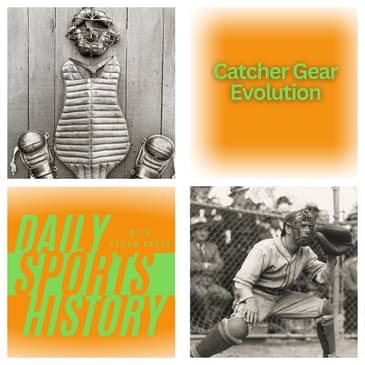
One of the scariest positions in sports is baseball's catcher. Not many other positions have the ball turn at them in excess of one hundred miles an hour consistently every day, with the player holding a bat merely feet away. And it's hard to imagine that when they first started to play baseball, they had zero gear. We're going to get into the evolution of the catcher's gear today on Daily Sport History. Welcome to Daily Sports History. I mean, then Reese your guide to a rapid deep dive into sports history every day. In the nineteenth century, the world of baseball was a far cry from the high tech stadiums that we have today. It was a time of true athleticism, but it was incredible risk for those playing the game, especially catchers. Imagine when baseball first started, there was no mask, no shin guards, no chest protector, and even no mitt. The catchers of the eighteen hundreds stood behind the plate, bare faced, bare handed, ready to face a thunder of pitches inning after inning. One such figure was Nate Hicks, a catcher for the New York Mutuals in the eighteen seventies. Hicks was among the first to challenge the traditional role the catcher, daring to move closer to the batter, risking injury for the sake of the game. But his bravery came at a cost. Hicks paid the price for his fearlessness in eighteen seventy three a foul ball struck him, causing severe damage to his face, nearly costing him his right eye. Yet, despite the Ricks, catchers like Hicks continued to push the boundaries, embodying the resilience and determination of the sport. Now it's time we meet Fred fair and in Mind at Harvard University in eighteen seventy six, there adapted a fencing mask from a fellow student at Harvard, and he used it to create the first catcher's mask. The introduction of the mask was met with skepticism in resistance. Its initial purpose was for protection, but it soon became a symbol of the ketcher's courage and determination. Then Roger Bresenan, the catcher for the New York Giants, took another leap forward in nineteen o seven. Ignoring the ridiculous crowd, Roger dunned shin guards for the first time, a move that sparked controversy, but the act was a turning point, paving the way for more acceptance for protective gear and baseball. The ketcher's mask and shin guards were not merely pieces of equipment. They were represented a shift in the mindset, as in the early eight to nineteen hundreds sports were very dangerous. Football had players dying and baseball did have a few deaths as well. So safety became more part of the game as the game wanted to continue to grow, and if people were afraid of dying, they would not grow. These early ideas of equipment caught the eye of a pioneer in the game, Albert Spaulding, which we talked about when the Spaulding Brothers started their company, and Spalding helped revolutionize the game by starting to wear a glove, and this was something that catchers especially grabbed onto, providing more and more padding as they went. Nowadays, the design is thicker than any other glove on the field to help absorb some of the quick throws they get from the pitchers. One piece of the catcher's equipment that we see today is the chess protector, which is made out of foam and different material now, but originally they used all different kinds of things for protection such as leather, foam, padding in T shirts or anything they could get to cover their chest but still be lightweight enough for them to move and still play the game of baseball. Over time, the mit, the mask, the glove, and the shin guards have all gone through major changes in their development. Now when you see a catcher take the field, they look like someone ready to go to war, and you almost can't see a spot where they can get hit by the ball other than their arms. This is great to help protect the players and keep them playing for years and years on because if a player went out there with no mint, no protection at all, we would all hold our breath and be scared because this would be a dangerous sport that may not be today. Thank you for listening to today's Daily Sports History like this. Follow us on our socials at Daily Sports History on Twitter, Instagram, Facebook, YouTube, and TikTok. We'd love for you to be part of our community as we continue to grow and come back tomorrow for more Daily Sports History