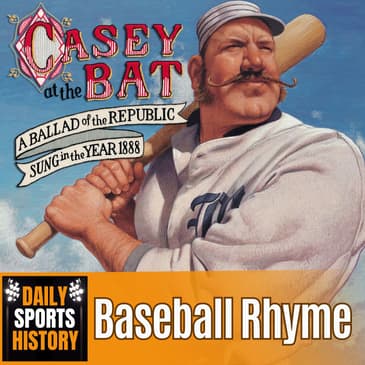
Join us on Daily Sports History as we explore the timeless baseball poem "Casey at the Bat." Dive into the dramatic narrative, the cultural impact, and the enduring legacy of this iconic piece of sports literature. Discover why Casey's mighty swing still resonates with fans over a century later.
#DailySportsHistory, #CaseyAtTheBat, #BaseballPoem, #SportsLiterature, #BaseballHistory, #IconicPoems, #SportsPodcast, #CulturalImpact, #PoetryInSports, #ClassicBaseball
Buy me a coffee: buymeacoffee.com/dailysportz
Newsletter: https://substack.com/@dailysportshistory?r=3en496&utm_medium=ios&utm_source=stories&shareImageVariant=light
DailySportsHistory.com
Email: dailysportshistory@gmail.com
YouTube: YouTube.com/@dailysportshistory
Twitter: twitter.com/dailysportshis
Facebook: facebook.com/profile.php?id=61551687917253&mibextid=ZbWKwL
On June third, eighteen eighty eight, Ernest fare gets his poem published by the San Francisco Examiner for the first time, and it becomes the most iconic sports poem ever written. Name of the poem is Casey at the Bat. Here's the history behind it and even a telling of the poem today on Daily Sports History. Before we get started today, I want to tell you about another great daily podcast called A little Bit dey Toto which means a little Bit of Everything, which is a daily podcast all about Latin culture. And here's a little preview. A Little Bit of Dodo is a podcast about a little bit of everything for curious minds of all ages. I'm Christina and you can tune in every weekday to learn about things like Sinko, the Mayo, Chihuahua's and volcanoes in Latin America. Episodes are bite sized, ten minutes long or less and always Latin American related. Subscribe and follow a Little Bit of Dolo podcast wherever you listen to podcasts. Welcome to Daily Sports History. I'm mean fin Reese, your guide to a rapid deep dive into sports history and today's trivia question to listen out for is who was Casey actually modeled after? Nowaday's going to be a little different. I'm going to tell you a little brief history of the poem and its impact on pop culture, and then I'm actually going to read you the poem. And if you never heard it, it's a great story and a great poem. Now let's start with Ernest Lawrence there, and that's up who penned this story. Now, he was born in He was born in Massachusetts, close to Worcester, and he actually attended Harvard University in eighteen eighty five where he graduated Magdame coo laude in philosophy, and soon after he moved and became a columnist for the San Francisco Examiner in eighteen eighty six, and this is where he would release his poem Casey at the Bet. Now, there's two questions that was always asked, as this was a fictional story, but it seemed very real, And the question was who was Casey? And is Mudville a real place? Now the answers to those are kind of up in the air. Many thought that National League player Mike King Kelly, who was famous in Boston, was actually the inspiration for Casey, as he had the personality of the Casey character and as he played in Boston, near where there grew up. But there later said that he actually got the inspiration for Casey, which was named after one of the Irish ancestors he knew for a player back when he was at Harvard and who was actually his best friend, Samuel Wilson. But that didn't stop Mike Kelly from saying he was Casey and actually went on to perform the poem as Casey in multiple iterations. Now, the other question was Mudville. Is it a real place as it seems like it was near Boston where he grew up, but many also claimed that maybe it was somewhere near San Francisco where he was living when he wrote it. And two cities actually claim to be the Mudville inspiration, Stockton, California and Holliston, Massachusetts. Now Thairnak actually says it's a made up place, he didn't base it off anything, but then didn't stop these two cities from claiming that they were the inspiration. Still to this day, now this poem has gotten huge acclaim It's been performed by Penn and Teller for a show. It's been animated by Walt Disney. The Cincinnati Symphony Orchestra actually composed a version of this using Hall of Famer Johnny bench In the orchestra's also been used and also been performed by numerous people, including James Earl Jones and Casey Caseum has also done his own rendition of Casey at the Mike. It's been included in Marvel and DC comic books, as well as multiple films such as What Women Want, The Dream Team, and even the two thousand and five bas News Bears, and it's also been featured in multiple TV iterations such as The Twilight Zone, How I Met Your Mother, One Tree Hill, Pokemon, The Simpsons, Friends, and Black Mirror. It's been used in the Play in the Cabaret multiple times and has been included in two iconic songs, center Field by John Fogerty and Rocky Mountain Way by John Walsh. And in in nineteen ninety six, the US Postal Service actually made a Mighty Casey stamp where they commemorated folk heroes in America, where they also had Paul Bunnyer and John Henry. So that's a little bit of the history behind Casey at the Bat. Now it's time to actually tell you the poem of Casey at the bat. The outlook wasn't brilliant for the Mudville nine that day. The score stood four to two, but one inning more to play. And then when Cony died at first and Borrows did the same, a sinkingly silent fell upon the page of the game. A straggling few got up to go to a deeper despair. The rest clung to that hope which spring eternal in the human breast. They thought, if only Casey could get a whack at that. They put even money now with Casey at the back. But Flynn proceeded Casey, as did also Jimmy Blake. And the former was a lulu, and the latter was a cake. So upon that stricken multitude, grim melancholy sat for there seemed but little chance of Casey getting to the back. But Flynn let drive a single to the wonderment of all, and Blake, the much despair, tore the cover off the ball, and when the dust had lifted, the men saw what had occurred. There was Jimmy safe at second, and Flynn a honking third. Then from five thousand throats and more there rose a lusty yell. It rumbled through the valley, It rattled in the dell, It knocked upon the mountain, and reckoned for Casey Mighty. Casey was advancing to the bat. There was an ease in Casey's manner as he stepped into his place. There was a pride in Casey, bearing in a smile on Casey's face, And when responding to the cheers, he lightly doffed his hat. No stranger in the crowd could doubt twas Casey at the bat. Ten thousand eyes were upon him as he rubbed his hand with dirt, five thousand tongues applauding when he wiped them on his shirt. Then, while the writhing pitcher ground the ball into his hip, defiance gleamed in Casey's eyes. A sneer curled Casey's lip, And now the leather covered spear came hurling through the air, and Casey stood a watching it in haunting gander. There close by the sturdy batsman. The ball, unheeded, sped. That ain't my style, said Casey. Strike one, the umpire said. From benches black with people, there went up a muffled roar, like the beating of a storm wave, and the stern distance, sure, kill him, kill, the umpire shouted someone from the stands. It's likely they'd have him killed had not. Casey raised his hands with a smile of the Christian clarity. Great Casey, the Sage shone, He stilled the rising tollumpt. He bade the game go on once more. The syphoid flew, but Casey still ignored it. As the umpire said strike two, Fraud cried out maddening thousands and echoed answered fraud. But one scornful look from Casey, and the audience wasn't all. They saw his face grow stern and cold. They saw his muscle strain, and they knew that Casey wouldn't let the ball go by a game. The stern is gone from Casey's lip. His teeth are clenched in hate. He pounds with cruel violence, his bat upon the plate. Now the pitcher holds the ball, and now he lets it go. And now the air is shattered by the force of Casey's blow. Oh, somewhere in his favored land, the sun is shining bright. The band is playing somewhere, and somewhere hearts are light, and somewhere men are laughing, and somewhere children shout, but there is no joy in Mudville. The mighty Casey had struck out. And that is Casey. The poem of Casey at the bat, Casey having a great pride and confidence in himself that he didn't even try on the first two pitches, but then he strikes out and all the fans are satin. So you can understand by hearing this if you've never heard it before, how engaging this poem is, and how it really does paint a picture of who Casey is, who the team is, the fans and everything going on. So it's a great understanding that this poem is the greatest sports poem ever written, and Ernest there really gave us something that will always be remembered. And I want to thank you for listening to today's Daily Sports History. I know it was a little different, but if you like this, please let your friends know, share it on all your socials or tag us on your socials. We'd love to hear from you. We'd love to be a part of your life and be a part of our community. And come back tomorrow for more Daily Sports History. And did you catch the answer to today's trivia question, who was the inspiration for Casey and Casey at the bat. It was Ernest Thayer's best friend in college at Harvard, Samuel Winslow