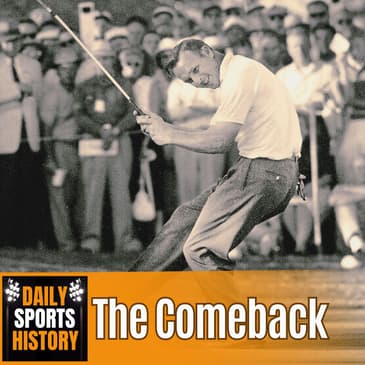
Join us on Daily Sports History as we relive Arnold Palmer's legendary comeback at the 1960 US Open. Discover how Palmer overcame a seven-stroke deficit in the final round to claim victory, cementing his status as a golf icon. Explore the dramatic moments, key shots, and lasting impact of one of golf's greatest performances.
Website: dailysportshistory.com
Email: dailysportshistory@gmail.com
YouTube: YouTube.com/@dailysportshistory
Twitter: twitter.com/dailysportshis
Facebook: facebook.com/profile.php?id=61551687917253&mibextid=ZbWKwL
Tiktok: tiktok.com/@daily.sports.history?_t=8hHPnNSCqfm&_r=1
#DailySportsHistory, #ArnoldPalmer, #USOpen, #1960, #GolfHistory, #LegendaryComeback, #SportsPodcast, #GolfLegends, #HistoricVictory, #GolfIcon
Buy me a coffee: buymeacoffee.com/dailysportz
Newsletter: https://substack.com/@dailysportshistory?r=3en496&utm_medium=ios&utm_source=stories&shareImageVariant=light
DailySportsHistory.com
Email: dailysportshistory@gmail.com
YouTube: YouTube.com/@dailysportshistory
Twitter: twitter.com/dailysportshis
Facebook: facebook.com/profile.php?id=61551687917253&mibextid=ZbWKwL
On June eighteenth, Arnold Palmer stayed one of the greatest comebacks in the US Open history when he came from seven strokes down to win the nineteen sixty US Open, defeating a young Jack Nicholson to win his very first the US Open. Here's the story behind how all this happened. Today on Daily Sports History. This episode is brought to you by our Weird World. Every week, I John Henson dive into weird, crazy and forgotten stories from the history books that you have probably never heard before. I try to put some humor into it, or maybe I just come off sounding like a dick. That's really up for you to decide. But join me every Monday subscribe everywhere that you get your podcasts. Welcome to Daily Sports History. I'm Ethan Reese, your guide to a rapid deep dive into sports history every day. And today's trivia question to listen out for is where did the term Grand Slam come from? Now? Arnold Palmer was basically born into golf, as he was born in Pennsylvania and his dad was the head professional and groundskeeper of the local country club, which gave him great insight into the golf and had him learning golf at an early age, and this allowed him to go to college at wake Forest and he actually enlisted to the US Coast Guard for three years, and after winning the NCAA Championship, he would turn pro in nineteen fifty five and would win his first major tournament, the Masters in nineteen fifty eight and in nineteen sixty, which made him the heavy favorite heading into the US Open, which is today one of the golf Grand Slams, which are considered the Masters Tournament, the PGA Championship, the US Open, and the Open Championship. Now, the term Grand Slam actually comes back from the nineteen thirties when the Grand Slam was the Open Championship, the US Open, the US Amateur in the British Amateur, which was won by Bob Jones in nineteen thirty and it was given that term by The Atlantic Journal's O. B. Keller, who dubbed it the Grand Slam, barring the term from the game Bridge. But in nineteen sixty they would actually go on to make a modern Grand Slam, as playing in the amateur tournaments wasn't as popular as many of the players were pro now and wouldn't start till nineteen sixty. After Alnra Palmer won the Masters in the US Open, and while on his way to the Open Championship, his friend Bob Drum, writer for Golfer's Life, Bob Drum suggested a modern Grand Slam adding in the PGA Championship, and Drums spread his idea throughout the media and it caught fire, and two years later the PGA Championship changed to stroke play and it started two weeks after the Open Championship instead of this same weekend, allowing it to become one of the major Grand Slam tournaments. But that probably wouldn't have happened if Arnold Palmer didn't go on to win the US Open, and it wasn't a surefire thing as Mike Sojak, who was a football player at Duke turned golfer, had two of the best first rounds in the US Open history, shooting a sixty eight the first round, taking the lead being three under par, and shooting a sixty seven in the second round, totaling one thirty five and giving him seven under par, shooting shooting one hundred and thirty five strokes, giving him seven under par a three stroke lead over his second place Doug Sanders, and at this point Arnold Palmer was not even in the top ten. Now. A thing to remember back then is even though they did play four rounds for the US Open, they did so in three days. They'd play the first two rounds in one day, so Thursday was the first round, Friday was the second round, and on Saturday they'd play round three in the morning and round four in the evening, making a very hard and long day for golfers, which is why they had changed this and now every round gets its own day. After the third round, Mike still had the lead and heading into the third round, Arnold Palmer was eight strokes behind behind Mike and wasn't even under par, so to think for him to even think about winning was a long shot. And after the third round things didn't get much better, as he was now just seven shots behind Mike, but still there was fourteen other players ahead of him as he was still in fifteenth place and also behind other great golfers heading into the final round such as Ben Hogan, Jack Nicholas, and Gary Player. And before that final round started, Arnold asked his good friend the Drum from the magazine if he had any shot even if he shot at sixty five and he thought he was just too far behind. There was no chance no matter what he shot. So Arnold went out there and just played as well as he could, and on the first hole, which was a par four, which he had bogeyed every single time, tim hitting it into the water on all the previous rounds, he missed the water and was able to get a birdie on that first hole and would go on to bertie five in the next six holes, shooting him into the leader board, and on whole eight would be the only bogey he would have, and by whole eleven he would have taken the lead away from US Amateur champion Jack Nicholas, who would go on to finish second, just behind Palmer, who shot at sixty five and won by two strokes, staging improbable comeback and changed the career of not only Palmer, but Jack as well. As Later on in life, Jack tells Arnold that if he would have won that tournament, it would have completely changed his career. He wouldn't have fought as hard as he wanted to and may have not won as many majors because he didn't have that drive anymore, and vice versa. Arnold after winning this actually let off the gas a little bit, as this was his coveted one that he wanted to win more than any other tournament, and when he finally won it, his drive went back a little bit and he would coast later on in his career. But for winning this US Open, he won fourteen thousand, four hundred dollars, which is roughly one hundred and forty eight thousand dollars today, which today a US Open winner will win three point nine million dollars. Just goes to show you how much golf has grown since then, which was largely helped by these two players in Jack Nicholas and Arnold Palmer. Now, Arnold will go on to win four more Grand Slams following this and would be inducted into the Golf Hall of Fame in nineteen seventy four and is often considered one of the greatest golfers to have ever played the game. And after this, he helped set up the modern Grand Slam, which has helped which has helped grow the sport even more as these four tournaments everyone looks to every year to watch to see who will win a Grand Slam. And I want to thank you for listening to today's daily sports history. If you like this, please share it with a friend. Word of mouth is the greatest way for us to continue to grow, and we want to continue to grow to give you even more sports history every day, and come back tomorrow for more daily sports history. And did you catch the answer to today's trivia question where did the term grand slam come from? It was Atlantis Journal's O. B. Keller who called Bob Jones nineteen thirty's grand Slam after using the term from the game Bridge