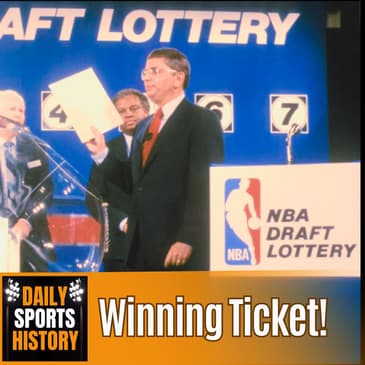
Step into the drama and intrigue of the very first NBA Draft Lottery in 1985-a game-changing moment that reshaped basketball forever. Discover why the lottery was created, relive the suspenseful envelope draw, and explore the legacy of Patrick Ewing’s selection by the New York Knicks. We’ll break down the controversies, conspiracy theories, and how the lottery system has evolved to shape the NBA’s competitive landscape. Perfect for sports history enthusiasts and anyone fascinated by the intersection of chance, strategy, and spectacle in professional basketball.
Check out Upside Swing NBA Draft Podcast
https://creators.spotify.com/pod/profile/bryce-w-hendricks/
Get the written podcast newsletter:
https://substack.com/@dailysportshistory?r=3en496&utm_medium=ios
📅 Listen now! 👉 DailySportsHistory.com 📲 Follow for more daily sports history insights!
Email: dailysportshistory@gmail.com
YouTube: YouTube.com/@dailysportshistory
Twitter: twitter.com/dailysportshis
Facebook: facebook.com/profile.php?id=61551687917253&mibextid=ZbWKwL
Bluesky: https://bsky.app/profile/dailysportshistory.bsky.social
https://www.instagram.com/dailysportshis/profilecard/?igsh=OWl1MzIyYndqOGU2
Threads
https://www.threads.net/@dailysportshis
#NBADraftLottery #SportsHistory #NBAHistory #PatrickEwing #BasketballLegends #NBADraft #SportsPodcast #BasketballHistory
Buy me a coffee: buymeacoffee.com/dailysportz
Newsletter: https://substack.com/@dailysportshistory?r=3en496&utm_medium=ios&utm_source=stories&shareImageVariant=light
DailySportsHistory.com
Email: dailysportshistory@gmail.com
YouTube: YouTube.com/@dailysportshistory
Twitter: twitter.com/dailysportshis
Facebook: facebook.com/profile.php?id=61551687917253&mibextid=ZbWKwL
Do you remember on May when one envelope changed the NBA forever, sending shock waves around the world as multiple teams were hoping for that one chance where their lottery ticket got them the jackpot. A new idea was sweeping across the NBA for a draft lottery to avoid taking going on in the NBA for teams to get the number one overall pick, and the league decided to institute a lottery, giving every team that did not make the playoffs a chance at the number one overall pick, and it provided teams with hope. It provided a conspiracy that all collided on one basketball stage. Join us today as we dive into the nineteen eighty five NBA lottery, the first of its kind that went on to change the league forever today on Daily Sports History. Welcome to Daily Sports History. I'm Ethan Rees, your guide as you daily learn more about sports history, increasing your sports knowledge. Now to learn about the NBA lotter, we first have to go back to what it was like before the NBA had what we largely use for most drafts ever since they started to be held. The worst team gets the first pick, and then the second worst team gets next pick, and so on. And so on and so on. Now this is a great strategy. It allows the team that had arguably the worst hunt, they got the worst record, and that's how they started from nineteen forty seven to nineteen sixty five traditional win loss record with a special toorial pick, which was a draft choice where a team could forfeit their first round pick and pick a player that played within fifty miles of their home arena, giving them a boost in fanfare. And there were twenty three territorial picks in the first iteration of the draft, and twelve of these players ended up being in the Hall of Fame, including players like Wilt Chamberlain, Oscar Robertson, Jerry Lucas. And it was a big moment, except it made it very hard. Depending on your location, you could have better players around you than other teams. So it made it very difficult and teams were starting to lose. It made it harder and teams wanted to lose were starting to lose, and so they introduced in nineteen sixty six a coin flip system where the worst team in each conference would determine who would have the first overall pick. The team who lost the coin flip would get the second one, and the rest of the first round would be determined in reverse when lost order. So it's essentially the same, except you separated the two conferences east and West, and you had a chance with whichever side you were on to win that first round pick. But that didn't mean you wouldn't stop taking, and you'd have a fifty to fifty chance number one pick and you have a good chance to get whatever player. And they did away with the territorial pick, allowing teams from all over the country to pick whoever they wanted and not miss out on great players. But teams were starting to do some things that were a little fishy. They started this new thing called tanking. Now we know taking as teams do it in all types of sports. They still do it today in the NBA despite this lottery. But the most notorious example was in nineteen eighty four with the Houston Rockets deliberately were trying to lose game to improve their odds of landing Hakeem Elijah On, who was thought to be a once in a generalation type of player and went on to be a Hall of Fame player that led the Rockets to championships. But is this what we needed. This is something that was starting to happen more and more as teams were seeing how good players were coming out of college and knowing if you got the number one pick, you got a chance to have a player that could change your trajectory forever. So after seeing these teams seemed like they were deliberately not playing players, not playing competitive towards the end of the season, trying to lose games, they wanted to change that because at this time TV was starting to get involved, but still it was largely based on ticket sales, and if you have teams that are not trying to win, you are not going to sell tickets. So the NBA Board of Governors got together and adapted a new lottery system for the nineteen eighty five draft. This would eliminate tanking, basically taking away the incentive to try to lose, meaning if you were the worst team with the worst record, it would not guarantee you the first pick, and they planned to make it a live televised moment where sealed envelopes would be placed into a container so you could see the randomness of what was going on. And then May twelfth, nineteen eighty five, the NBA held its very first lottery on television. They had seven picks among the non playoff teams, and each team with an equal chance at the number one pick, which was a fourteen point two nine percent chance, So it didn't matter if you missed the playoffs, you had a chance the number one pick. It didn't matter at the end of the season if you were going to make the playoffs or not. You could still play for something, and players would play for contracts, and the event was broadcast live on National TV, adding suspense and transparency to the process. They didn't want it to be behind closed doors and teams thinking, oh, you picked them because you're trying to collude and have conspiracies, which we'll get into that later. Seven envelopes, each containing a non playoff team's logo, were placed inside a transparent drum, and Commissioner David Stern personally drew out the envelopes one by one, establishing the draft order, and the first envelope drawn would get the first pick, followed by the rest of the order, and that revealed that the New York Knicks, coming off at a twenty four and fifty eight season, had won the very first pick, sparking joy throughout the New York fan base, as that meant they had the chance to select presume number one overall pick Patrick Ewing a consistens everyone knew he was going to go number one and he was a future Hall of Famer, changing the NIXT trajectory to being a dominant powerhouse throughout the late eighties and into the nineties. The Indian Pacers got number two, and they went Waynsman Tisdale out of Oklahoma who never made an All Star Game. Number three was the Los Angeles Clippers who selected Bint Beignette Benjamin, a Sinner from Creighton who also never made an All Star game. Number four was the Seattle SuperSonics who selected Xavier McDaniel, who did go on to be an All Star out of Wichita State. Number five went to the Atlanta Hawks, who selected John connect out of SMU who never made an All Star. And then number six was the Sacramento Kings who selected Joe Klein out of Arkansas who never made an NBA All Star. In the last team to select in the lottery, who essentially lost the lottery, meaning they got the last pick, was a Golden State Warrior who may have won out as they picked Chris Mullins, who went on to become a Hall of Famer. The first seven picks wasn't all this draft. In fact, this draft actually went into seven rounds, which is crazy to think as today we only have two Many of these players wouldn't go on to play in the NBA, but there were a few more Hall of famers. At pick number thirteen, the Utah Jazz selected Karl Malone, and at pick number eighteen, the Detroit Pistons selected Joe Dumar and in round number four, the Atlanta Hawks selected r Vetus Sibonis, who has a crazy story about how he made it to the NBA. But what this goes to show you is that the lottery isn't everything, but it's important as there were three other Hall of Famers picked outside of the lottery that year. But in the first seven picks there were two Hall of Famers. But the big prize, the one that ever everyone wanted, everyone thought would change the outcome of their team, was Patrick Ewing. Now there was controversy in this that has come out more recently as people can analyze videos a little bit more, and the thought is the New York Knicks is the biggest market in America. There are more people in New York to root for the team, to cheer for the team, so you have more eyeballs, you can get more butts in the seats. It's what was thought. So by the New York Knicks winning the first pick, they thought something had to be a miss. Now, if you watch the clips of what actually happened, it's on YouTube, you can watch it. There is one thing that's a little different. But if this was what happened, it was one well rehearsed and two just kind of crazy that that's how it worked out. So they had seven envelopes and they placed them all in a clear cylinder to be rotated around and mixed up before they picked out the lottery. But when they put in the Knicks envelope, it got kind of bent on the side just a little bit. And the thought was they did that so they could know which one was the Knicks, so they could pick that one last. And they also speculated that maybe they actually froze the envelope so that when Commissioner Stern picked out the envelopes he could tell which one was cold to be the Knicks. Now, this is all speculations. There's no nothing to confirm these claims. The bent corner probably just happened. The frozen envelope, it is just something that people will say. There's no confirmation of this. But you know, conspiracies, how they loved to rear their head into our every day live and there have been some other type of conspiracies because of the lottery. Sometimes luck looks a little odd because the NBA would have wanted that to happen. We had it with the Knicks getting Patrick Ewing, and then we had it with the Orlando Magic being a new expansion franchise, getting Sequille O'Neill. And then again we had it with Lebron James when he he entered the draft getting picked by his home team, the Cleveland Cavaliers. But luck happens too. It's not all conspiracies. Conspiracies always come up, and conspiracies aren't always about aliens in the government. They're also about our sports teams and we love. But Patrick Ewing was a great prize. He was an NCAA champion, the Player of the Year, three time All American. He was a clear number one pick, so clear that at the lottery they actually had a Patrick Ewing jersey already made. It's like it was a hands down, drop down. This is gonna be the number one pick. And Ewing went on to sign a ten year, thirty two million dollar contract with the Knicks, and despite battling injuries, his rookie year would average twenty points in nine rebounds a game, earning Rookie of the Year honors, showing immediately that the Knicks had won the lottery by getting a great player. Ewing went on to play fifteen seasons for the Knicks, making the playoffs fourteen times, becoming the Knicks all time leader and points, rebounds, blocks, studios, field goals made, and played over one thousand games for the team, averaging twenty one points and almost ten rebounds a game throughout his career, becoming an eleven time All Star and seven time All NBA selection, and be inducted into the Basketball Hall of Fame in two thousand and eight and be named to the NBA's seventy fifth anniversary team. But the NBA lottery was not done. See the problem was that it was the lottery system did help the tanking narrative that there was no reason to tank, but it also created so much unpredictability and if you were just unlucky in the worst team in the league, you probably stayed the worst team in the league because you couldn't get that number one pick or you didn't have the best odds to get that number one pick. So in nineteen ninety they introduced a weighted lottery system, teams with the worst records better odds to pick the top pick, discouraging tanking while maintaining the element of chance. Now, this system has continued to evolve over the years, and the reason being that even having the biggest chance of the number one pick, people still tank for and tanking is something that still happens to this day. So they have justed the percentages now the top three losing teams, so the three teams with the worst record in the NBA get the same odds of winning the number one pick, so you have no reason to really bottom out. I want to thank you for listening to today's daily Sports History, and if you want more NBA Draft content, check out the Upswings NBA Draft podcasts, where your hosts, Bryce Cooper and Stone focus on everything center around the NBA Draft. They aim to bring you top notche analysis of prospects and every possible angle and discuss how they may impact a team's fit at the next level. We'll put a link in the description below for you to check them out. And if you enjoy today's Daily sports History, please follow us on our socials. We're Daily Sports History on Twitter, Instagram, Facebook, blue Sky, Threads, Massive LinkedIn, wherever you like to socialize. You can check out our post on there and come back tomorrow for more Daily Sports History.