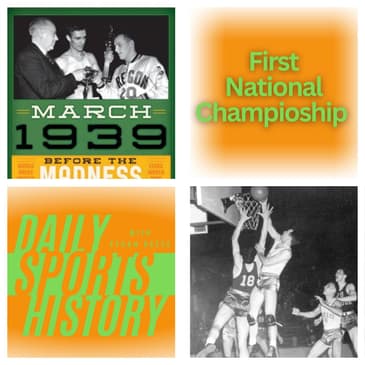
Join us as we relive the championship game between the Oregon Webfoots and the Ohio State Buckeyes, a thrilling showdown that marked the culmination of the first-ever NCAA basketball tournament. From the high-flying action to the electrifying atmosphere, discover the excitement and drama that surrounded this landmark event.
Through concise storytelling, we capture the essence of the 1939 college basketball championship, its significance in the evolution of the sport, and the enduring legacy of March Madness.
Tune in for a quick layup through basketball history as we celebrate the dawn of a storied tournament.
We are being featured on PODCAST GURU:
https://app.podcastguru.io/podcast/daily-sports-history-1715849627
Website: dailysportshistory.com
Email: dailysportshistory@gmail.com
YouTube: YouTube.com/@dailysportshistory
Twitter: twitter.com/dailysportshis
Facebook: facebook.com/profile.php?id=61551687917253&mibextid=ZbWKwL
Tiktok: tiktok.com/@daily.sports.history?_t=8hHPnNSCqfm&_r=1
#sports #sportshistory #sportspodcast #podcast
Buy me a coffee: buymeacoffee.com/dailysportz
Newsletter: https://substack.com/@dailysportshistory?r=3en496&utm_medium=ios&utm_source=stories&shareImageVariant=light
DailySportsHistory.com
Email: dailysportshistory@gmail.com
YouTube: YouTube.com/@dailysportshistory
Twitter: twitter.com/dailysportshis
Facebook: facebook.com/profile.php?id=61551687917253&mibextid=ZbWKwL
On March twenty seventh, the University of Oregon beat Ohio State to win the very first NCAA Basketball Championship in Evanston, Illinois, the start of a tournament that takes the nation by storm every year. And here's the story behind this important moment in sports history today on Daily Sports History. Welcome to Daily Sports History. I'm Ethan Reese, your guide to a rapid deep dive into sports history every day. Now. Previously, we mentioned in another episode about the NAIA that they held their basketball tournament in thirty seven, and then there was the n who held their first tournament in nineteen thirty eight. So the NCAA was the third national tournament and the only one actually recognized by the NC DOUBLEA. Now, the winners of the other tournaments were actually NC DOUBLEA universities, but the concept for the actual tournament was actually pitched by Harold Olsen, the coach for Ohio State, the team that lost the very first national championship, and when seeing the popularities of the NAIA in the n tournament, the NC Double A of course joined in and it was helped organized by the National Association of College Coaches, which was started to help make the game more unified throughout the country. Now, they decided to have an eight team tournament featuring four teams from the East and four teams from the West, and during the first round, the West teams would play in San Francisco and the East teams would play in Philadelphia. Now, at the time, they invited multiple teams, but like I said earlier, there were those two other tournaments and not everyone. No one wanted to be in this tournament, so they didn't necessarily have the best teams at the time. But that being said, nothing stopped them from being in multiple tournaments, so there were teams that did both. But the teams featured in the East were Brown, Ohio State, Villa Nova, and wake Forest, and on the west was Oklahoma, Oregon, Texas, and Utah State. All the teams featured had a winning record, with Oregon having the best record overall at twenty six and five. So Ohio State was able to come out of the Eastern bracket beating wake Forest and Villanova, and Oregon came out of the West bracket beating Texas and Oklahoma. Ohio State was led by their coach Harold Olsen. They went fourteen and six that year, beating teams such as UCLA in Michigan, but losing to the likes of Indiana Purdue in California. And originally they weren't even the first team picked for the East out of the Ohio region, as Bradley was offered, but they decided to go to the n and the Buckeyes were the second twice, but a good one. An organ which at the time were known as the Webfoots instead of the Ducks, were led by Howard Hoopson, and they were actually called the Tall Firs because they had one of the tallest line ups in the nation, but by today's standards, weren't actually that tall. They averaged over six foot tall, but their tallest was at six ' eight which, thinking about today's National championship teams usually have multiple players over six eight. But the game was held at Northwestern University and organ style of basketball was more of a fast break Since they were taller, they could get more rebounds in blocks and get on the fast break and scored more often, and they took their early lead six to zero, but Ohio State fought back to make the score twelve to eleven, but Oregon then again took control and at halftime, the score was twenty one to sixteen. I know it sounds like a barn burner compared to today's standards, but this was more of a high scoring affair than the average basketball game at the time. Because there were no shot clocks, plays took longer to develop. In the second half. Ohio State quickly came back with a couple of field goals and the score was now twenty one to twenty, but then the Oregon Webfoots took over, making the next four baskets, exending their lead and never relinquishing, and finishing the game forty six to thirty three. After the game, the Coaches Association reported that they had a loss of over two thousand dollars putting the the event together due to the attendance at all the games, which caused the College Coaches Association to let the NCAA take control of organizing the event and financially back the tournament in the following years, which is what helped it continue to grow, but it took many years before it would pass the NAIA and the n tournament for popularity and have the sole national champion for their tournaments, but it was a great start for the March madness we know today. Thank you for listening to Daily Sports History. If you'd like this, please like and review wherever you're listening. We'd love to see how much you're enjoying the show, and that's a great way to do it. And come back tomorrow for more Daily Sports History.