Buy me a coffee: buymeacoffee.com/dailysportz
Newsletter: https://substack.com/@dailysportshistory?r=3en496&utm_medium=ios&utm_source=stories&shareImageVariant=light
DailySportsHistory.com
Email: dailysportshistory@gmail.com
YouTube: YouTube.com/@dailysportshistory
Twitter: twitter.com/dailysportshis
Facebook: facebook.com/profile.php?id=61551687917253&mibextid=ZbWKwL
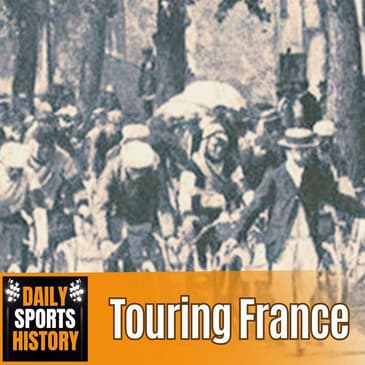
On July nineteenth, nineteen o three, Maurice Garin becomes the first ever winner of the Tour de Front, completing the two thousand, four hundred and twenty eight kilometer race, which is over one thousand, five hundred miles, lasting nineteen days in six stages, and is one of the most grueling by races ever to be done. Here's a story behind it today on Daily Sports History. Welcome to Daily Sports History. I'm Ethan Reese, your guide to a rapid deep dive into sports history every day now. The Tour de France was the idea of Henry Dsgrange, the editor of the sports newspaper Le Atto, and this was done as a stunt to help sell papers. He would sponsor this great event and that's how this would be done. And this was common back in the day, just bicycle races or this was around the time cars were being made and motorcycles, so they had also those types of races going on, anything that would get the reader's attention and want them to read their story. And after returning from a bicycle race in Paris, that's when he had the idea to hold a race around the entire country of France, similar to the six day races that were common in Britain, and it would be a long race in a long time, and it was originally supposed to be a five week race starting June one, going all the way to July fifth, but they had to push it back as they didn't have enough competitors as only fifteen competitors had signed up and paid the twenty franc fee. So what they did was they increased the prize money to twenty thousand francs and reduced the fee to ten which caused an influx and they ended up with seventy nine cyclists signing up for the race, but only sixty would end up starting the race. And so they had the idea to run this in six different stages and each stage would average about four hundred kilometers, which is roughly about two hundred and fifty miles just by comparison now the race is more than half of that mileage as back then they also didn't have any breaks in between the days and they actually went and back then they weren't allowed to run in teams, so it was all an individual event, so there was no drafting and you didn't have support systems, so you'll see photos of this time where it looks like all the riders have an X over them, but actually they have bicycle tires over them, making a shape of an X over them, because if the bicycle tire popped, they themselves would have to fix it. Didn't go through any mountain passes, but they did have some elevation. They had go to as high as thirty eight thousand feet and normally at this time professional cyclists would hire a pacer to keep up with them, similar to what teams do now, but this was forbidden as the organizers of the race wanted it to be a single person race, and they would post different people to watch the riders throughout the night, as most of the rides would start at night and finish during the next day, just to keep track of all the riders, making sure no one was veering off course. And instead of what they have today, the leader of the race wears a yellow jersey so he can be followed. Back then they just wore a green armband and you could actually earn extra money because the fastest eight cyclists would win a prize for being the fastest cyclist at that time. All the way up to fifteen fifteen hundred francs, so there was incentive to win each and every stage, and if you gave up on a stage, you could also compete in the next day stage, but you wouldn't be considered in the general classification, which means you wouldn't be considered in the option to win the entire race, but you could win those small bonuses, so you would still want to compete. And so sixty riders came to the starting line on July fir to compete in this very first Tour de France, which is essentially, if you look at a map, is a circle around kind of the outer edges of France, not the exact edge, but towards the outer edges, kind of leaving the middle open. And there were forty nine Frenchmen, for Belgium, for Swiss, two Germans, and one Italian, and twenty one of them had bicycle manufacturer sponsorships and thirty nine were without commercial support, and there was twenty four that actually just entered into specific stages instead of doing the entire race. So the race is set to begin and the favorites are Maurice Garan in Hippolyte good There. Now, Garran actually started out with a strong performance on the first stage, which was a four hundred and seventy kilometer stretch from Paris to Leon, which is two hundred and ninety three miles. They started after three pm and they did not finish till the next morning around nine, and Hippolyte actually got stomach cramps and was unable to finish the first stage, which meant he wasn't eligible for general classification, so he could not run the whole toward de France, and Garan actually won the first stage by one minute. Now they held the second stage four days later on July fifth, which was from Leon to Marseille, which was three hundred and seventy four kilometers or two hundred and thirty two miles. Now, this stage was through the mountains, which is why it's a little shorter, but made it even more difficult as the first stage was more of a flat plane. And even though Hippolyte didn't finish the first stage, he was able to enter into the second stage and won this one, getting the stage bonus. But Maurice Garan was still the leader of the race and the next stage was from Marseille to Toulouse, held three days later on July eighth, which was another four hundred and twenty kilometers or two one hundred and sixty three miles, and luckily there was no more mountain stages at this one was a plain stage as well, and Hippolyte was again the winner of this stage, but he would be unable to win the whole tour, but he got the bonus for this now. The next stage was held on July twelfth, from Toulouse to Bordeaux, which was the shortest trick in the whole race, only two hundred and sixty eight kilometers or one hundred and sixty seven miles, and this one was won by Swiss writer Charles Lesser. But even after this Maurice gurn was still in the lead, and a day later, on July thirteenth, they had their fifth leg of the Tour de France from Bordeaux to Natles, where Maurice Gern actually won this stage and continued to his lead, and the final stage was held on July eighteenth, from Natles to Paris, making a full circle around the country, and the final stage was four hundred and seventy one bilometers or two hundred and ninety three miles, the longest stage of the entire nineteen oh three Tour de France, which was won by Maurice Geeran, giving him the general classification for the whole Tour de France, giving him the bonus for the stage and the whole purse for the entire race, And they didn't finish that section till the following morning, as all these races started in the afternoon or evening and finished the following morning, So all the writers at this time for the Tour de France were writing at night, something very different than what's done today, as they're all ran during the day now. And Maurice Gieran not only was he the favorite, he actually won by almost three hours, beating fellow Frenchmen Luscine Pother and six Frenchmen ended up being in the top ten, with one Italian and three Bulgarians. Remember this was put on for a sports newspaper called Leotto, and they put out a special edition which sold over one hundred and thirty copies when the race was over, which was more than four times their regular circulation. And Maurice gurn was a national hero, and he returned to defend his title in nineteen oh four, but failed to do so. Dudu disqualification. Now over the entire race, he was able to secure over six thousand francs, which is roughly about sixty thousand dollars today in the US money, and the twenty twenty three winner of the Tour de France took over two and a half million euros. So the race continued to grow over the years and gets attention all over the world, not just in France. And as for Gearon, he later retired from bicycle riding and took his winnings to buy a gas station where he worked for the rest of his life. And that was the very first Tour de France. If you like that story, please stop what you're doing and text somebody, Hey, have you ever heard about the first Tour de France. Check it out so that you both can talk about how crazy the first Tour de France was and come back next week for more Daily sports history.