Buy me a coffee: buymeacoffee.com/dailysportz
Newsletter: https://substack.com/@dailysportshistory?r=3en496&utm_medium=ios&utm_source=stories&shareImageVariant=light
DailySportsHistory.com
Email: dailysportshistory@gmail.com
YouTube: YouTube.com/@dailysportshistory
Twitter: twitter.com/dailysportshis
Facebook: facebook.com/profile.php?id=61551687917253&mibextid=ZbWKwL
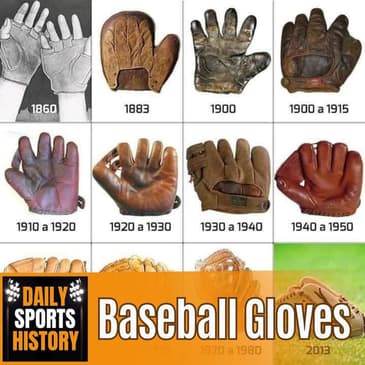
On August 22, 1922, a new baseball glove received its patent, which saw a deeper webbing between the thumb and the pointer finger, looking more similar to the gloves we have today, and was one of the final gloves to not have all the fingers connected. Today we're going to dive into a brief evolution of the baseball glove on Daily Sports History. Welcome to Daily Sports History. I'm Ethan Reese, your guide to a rapid deep dive into sports history every day. And today's trivia question is, what position were the first to use baseball gloves? Now today, playing a game of catch or having a mitt that you haven't seen in a while, or everybody having a mitt in their house is very common. And we don't often think about how that mitt came to be. We often just think it's always been there, but it hasn't. And it's had a lot of evolution through the years. As when baseball first started, there were zero mitts. It was all bare hand. Even catchers caught the ball bare hand. And many catchers broke fingers, had welts and bruises. As they used to stand far back from the home plate, because of this, they didn't have a mitt to help them catch the ball. And if a pitcher's throwing the ball 80, 90 miles an hour, it's going to hurt your hand no matter what. And if you've ever caught a baseball with your bare hand, You know it's got a stinging sensation. If you catch it just right with your fingertips and a little bit in your palm, it doesn't hurt as much, but the chances of you catching a ball just right with your hand is very difficult, especially in a game situation. So players... around the 1870s, started to experiment. And Doug Allison was the first to use a glove at the catching position. And what this glove was, was it looked like what workout gloves look today, where it's just a fingerless glove with some padding in the palm. So it's a very simple looking glove. And then five years later, Charlie Waite was the first to be recorded using a glove at first base. Now, this makes sense that catcher and first base were the first to innovate using gloves because the ones where they had the ball thrown at them the most, the catcher from the pitcher and first baseman from basically everywhere in the infield trying to get that batter out at first. But gloves didn't really take off until Albert Spalding, who was a part of our Brothers episode we covered previously. And if you remember from that episode, he was the first to really get gloves going. And not only because he was a great athlete, in baseball, and it allowed him to be a better player. As players didn't wear gloves because they thought it wasn't manly. You weren't a man if you couldn't hold a glove like this. And it's often done in sports. In football, you're not a man if you wear a helmet. You're not a man if you wear these pads. In boxing, you're not a man if you wear gloves. All these sports, it's often thought about. But these innovations that are thought of as unmanly really are just better for the league. Because of the glove, you can feel better. Because of that, you don't have to worry about pain and you can play more. And that is really what revolutionized. And Albert starting this, along with starting his company with his brother, really helped grow it. He had the connections and he knew exactly what baseball players wanted. what they wanted, and what they didn't want. Because of that, it helped grow that brand, and it helped really grow baseball gloves all over. Now, gloves went through a lot of different things. As we first started with that workout-looking glove, and then we went to a glove that kind of looks like an oven mitt in the 1890s, which is just kind of a mitten where you have the thumb by itself and no fingers at all, and just some padding around the palm area. And then you go... Then in the 1900s, catchers had a new kind of mitt, which was really kind of looks similar to what if you've ever seen boxers train, the guy they're training with has those flat padded things for the boxer to punch. That's really what it looks like. It's there's not much to it. You can't really squeeze. It's just to stop the ball. And then you kind of drop it down into your hand. So it was a lot harder to catch with, but it helps your hands a lot. And in the field, they would have a glove that looks similar to if you've ever seen gloves that are for firewood, for heat, where you have all fingers, but it's very thick leather glove. That's what these gloves look like in the field. Very thick glove with some padding along the thumb and palm area. And all the fingers were not connected. And they richly worked their way up to have a little bit of webbing at the bottom between the thumb and the pointer finger. Then in the 1910s and the 1920s is when we started to get the webbing between the thumb and the pointer finger. Now this was done a few different ways. You had a strap. You had a few that were just kind of a leather lace between the two. But at this time, they still didn't have the fingers connected. So you would only have the thumb and the pointer finger connected by this webbing. which is similar to what we have today, but a very primitive way of doing it is either just one strap or just like two lines of leather going back. And then all your fingers could still move. Then in the 1930s, they started to use those straps that they connected the thumb and pointer finger together to connect all the other fingers. So you had more of a mitt-like thing, which is why we call it a mitt, because it kind of looks like a mitten that you wear in the snow in the wintertime, especially when you're a kid. It is more common to what we see today. And from that point, there hasn't been a whole lot of structural differences to the glove. As they have increased the webbing, made it a bigger webbing, and had the fingers always closer together and make it more of a mold to fit the ball. But it's really kind of simplistic. Sometimes the webbing is complete where you can't even get see-through. Sometimes there's some see-through. But really, between the 1950s and today... Baseball mitts are pretty similar. Quality of making it is better as it's able to handle more force as there's more force from pitchers and players today from how they throw. And we have more specialized from catcher's mitts to first baseman's mitts. We even have mitts for ambidextrous pitchers, which is a six-finger mitt. And each... position kind of has different kinds of gloves. Infielders tend to have a shorter glove compared to outfielders that tend to have a much taller glove, a much bigger and taller glove as they're catching more pop fly. Infielders are getting more ground balls. It's all kind of a preference of the player. And there's also been other companies besides Spalding that have come out. Wilson has come out with gloves that have become very popular as well as Rawlings has become a major player in the baseball glove world too. And in the 1950s, they also started to brand the leather, which kind of burned the leather to put a player's name or player's signature in there. As around this time in the 1950s, players started to be endorsed by these baseball companies. As TV rides were coming and baseball players were becoming more pop culture, this allowed them more to grow and it allowed them to have signature gloves. And I'm sure all of us grew up having a specific player glove. I grew up having a Ken Griffey glove. And as you go to the store, you'll see a player's name in there that you probably know because they're probably really famous. You probably know almost all gloves now that you buy do have a player related to that glove. So if you have a player you like, you can probably get a glove similar to what they use. Will it be exactly the same? Maybe. Maybe not. Every player is a little different. But all these players are sponsored. and their gloves are sponsored, and that started in the 1950s. And if you go back and you ever find one of those original gloves, one of those fingerless gloves, it's worth about $ 10, 000. If you can find one of the first baseball gloves before they had the webbing between the fingers, those gloves consistently go for above $ 5, 000. In the baseball memorabilia market, as they are continuously being harder to find and in good quality, as baseball players use the same glove over and over. I know most of us probably use the same glove from when we were younger to now. And gloves have consistently been made with leather that usually stands the test of time. And unless you play one of those positions of catcher or first base where you're constantly, you're probably not going to have to replace your glove too much, which shows how far we've come and shows how great we got it. To look at a 950s glove and know that that's a baseball glove Even though it looks a little older, a little different, but the same basic structure to today's glove is really impressive that we got it right so quickly. And guess what? No one has thought of not being a manly player now that they use gloves. It also helped baseball as within the first few decades, defensive efficiency went up a large amount in that first few decades of the 1900s. Because players were starting to use gloves. And if you all know, a glove helps you catch the ball. Helps you field ground balls. It helps you so much in playing defense. And as players started to use gloves, it helps erase at least one error from every team's game. And it also became known as the dead ball era. Because the defense got so much better than the hitting did. So innovation in the sport helped lead to an era of I want to thank you for listening to today's Daily Sports History. And if you have a topic you would like us to cover, please. leave us a rating review wherever you're listening. Leave your name and the topic you want us to cover and we'll get that done just for you. And come back tomorrow for more daily sports history. And did you catch the answer to today's trivia question? What position were the first to use baseball gloves? And the answer is were catchers and the first was Doug Allison who was the first recorded catcher to use a baseball to use a glove which was really similar to our fingerless workout gloves today