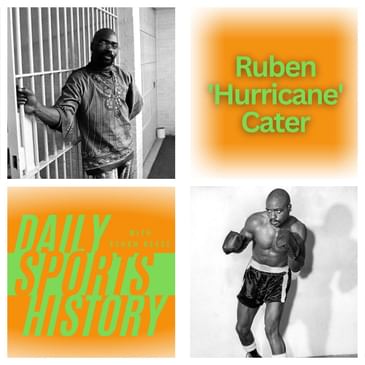
From his rise as a promising middleweight contender to the wrongful conviction that shook the foundations of the justice system, delve into the trials and triumphs that defined Carter's tumultuous journey. Explore the captivating saga of perseverance, activism, and the pursuit of truth that transformed him from a boxer into a symbol of resilience.
Through concise storytelling, we capture the essence of Rubin "Hurricane" Carter's indomitable spirit, his impact on civil rights movements, and the enduring legacy of a man who fought against the storm of injustice.Tune in for a quick yet powerful glimpse into the life and legacy of Rubin "Hurricane" Carter—a story of courage in the face of adversity.
Website: dailysportshistory.com
Email: dailysportshistory@gmail.com
YouTube: YouTube.com/@dailysportshistory
Twitter: twitter.com/dailysportshis
Facebook: facebook.com/profile.php?id=61551687917253&mibextid=ZbWKwL
Tiktok: tiktok.com/@daily.sports.history?_t=8hHPnNSCqfm&_r=1
#sports #sportshistory #sportspodcast #podcast
Buy me a coffee: buymeacoffee.com/dailysportz
Newsletter: https://substack.com/@dailysportshistory?r=3en496&utm_medium=ios&utm_source=stories&shareImageVariant=light
DailySportsHistory.com
Email: dailysportshistory@gmail.com
YouTube: YouTube.com/@dailysportshistory
Twitter: twitter.com/dailysportshis
Facebook: facebook.com/profile.php?id=61551687917253&mibextid=ZbWKwL
On March seventeenth, nineteen sixty six, Reuben Hurricane Carter's boxing crew ended after he's wrongfully convicted of killing three patrons at a bar in New Jersey. Here's a story behind this monumental moment today on Daily Sports History. Welcome to Daily Sports History. I'm Ethan Reese, your guide to a rapid deep dive into sports history every day now. Reuben Carter was no saint. He had had troubles with the law before, but then it means he was a killer. Born in New Jersey, he had a rough childhood with seven kids, struggling financially, and at one point, when he was eleven, he was sentenced to juvie for assault after stabbing a man who allegedly tried to sextually assault him. He had later escaped you and joined the US Army, serving in Germany, where he actually learned to box there. While in the Army and after he was discharged, he was sent to prison after he was convicted of two different muggings. He was released in nineteen sixty one and that's when he began his boxing career. After honing his skills in the army and in prison, he was a middleweight fighter, and he got the nicknamed Hurricane due to the fact that he wasn't that big at five eight, one hundred and fifty five pounds, being aggressive in the ring and his paunching power packed a hurricane and by nineteen he was in the top ten of middleweight contenders, and in nineteen sixty four he got his big break fighting for the middleweight title, unfortunately losing in a fifteen round bout by Yunana's decision in favor of Joey Gardelio. He would continue to fight up until nineteen sixty six and had a record of twenty seven and twelve with fluted nineteen knockouts, but his career didn't end on his own. Sadly, he was at the wrong place at the wrong time, because at approximately two third on June seventeenth, nineteen sixty six, in Patterson, New Jersey, two men came into a bar and shot the bartender and a couple customers with a shotgun and a thirty two pistol. Unfortunately, Carter and his friend John Artists happened to be in the area at the time at a different bar and happened to drive by in a car that matched the description that the police were looking for, despite the two not having any firearms with them and not matching the descriptions as they were looking for light skinned from Americans with hair and beards, neither of which matched those descriptions as they were both darker skinned and Carter had a distinctive bald head and mustache. That didn't stopped the police and the prosecutors from bringing evidence and hiding evidence against them. Despite no physical evidence and only the testimony of two jail informants, Hurricane, Carter and his friend John Artist were convicted of three murders and sentenced to life in prison by an all white jury, but in nineteen seventy four, with pressure from the press and some predominant famous figures such as Muhammad Ali, who helped support the two in their appeals effort, even Bob Dylan wrote a song called Hurricane in which he declared Carter's innocence he actually sung at a concert at the Tritton State Prison, and they were granted a new trial based on the fact that the two informant witnesses they had they had evidence where they had both lied and perjured themselves to convict the two on tape, and the two were released on bail, but later tried in nineteen seventy six again with a new jury, getting the same results, including the two same informants that they had before. And it was until nineteen eighty five when Carter's attorney filed a hapeas corpus in federal court due to the way the prosecution had handled the case, and a year later Judge H. L. Sorkin granted this, allowing Carter to go free without bail November nineteen eighty five, and following his emancipation, he moved to Toronto, but he continued to use his influence that he had to help others and had been rodin fully convicted, becoming the executive director of the Association in Defense of Wrongly Convicted, which he headed up for over twelve years. Unfortunately, in twenty twelve he contracted prostate cancer and passed away. And there is a great movie called Hurricane starring Denzel Washington, which loosely follows this story. But Carter had a rough going of it, but he made the best of what he could, and he fought for not only his himself in the ring and in the courtroom, but also fought for others. After he got out, and I know many are grateful for all that he did. Thank you for listening to today's Daily Sports History. If you enjoy this, go tell a friend say, hey, let's listen to this together and have a good time expanding our knowledge of sports history. And come back tomorrow for more Daily Sports History.