Buy me a coffee: buymeacoffee.com/dailysportz
Newsletter: https://substack.com/@dailysportshistory?r=3en496&utm_medium=ios&utm_source=stories&shareImageVariant=light
DailySportsHistory.com
Email: dailysportshistory@gmail.com
YouTube: YouTube.com/@dailysportshistory
Twitter: twitter.com/dailysportshis
Facebook: facebook.com/profile.php?id=61551687917253&mibextid=ZbWKwL
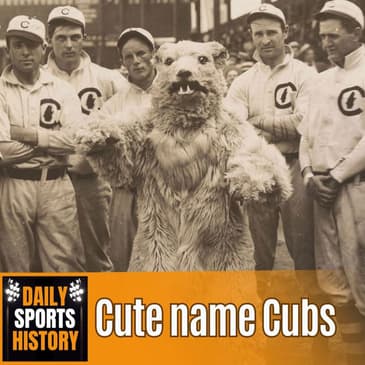
On March twenty seventh, nineteen oh two, the top baseball team in Chicago officially becomes the Chicago Cubs, going from a journey where they originally the White Stockings and had multiple other transformations and names before it was settled on the Cubs, which they took and held onto for over a century, now giving its unbreakable bond between the team and the fans. And then why they got this name was very different than how teams are named today. We're gonna dive into this unique history of one of baseball's most iconic teams and discover how the Cubs became synonymous with the city of Chicago and they became just as lovable as some. Little bear Cubs today on Daily Sports History. Welcome to Daily Sports History. I'm Ethan Reese. You as you daily learn more about sports history, increasing your sports knowledge as we learn about the origins of the Chicago Cubs. And today's trivia question to listen out for is what is the best winning percentage ever in a season by a Major League Baseball team? Listened throughout the episode for the answer. If you miss it, I will give it to you at the very end. Now let's go back to the seventies. No, not the nineteen seventies, the eighteen seventies. In eighteen seventies, the Chicago White Stockings made their debut with a huge victory forty seven to one over Louisville at Dexter Park. This was beginning of one of the most iconic teams in baseball, and not so long after the very first professional team in the Cincinnati Red Stockings, which we talked about in the previous episode, and the team name. They had the White Stockings derivative similar to the Red Stockings, as they wore white stockings just like the Red Stockings were red, and this gave them a sense of professionalism and pride that was significant in early baseball. Now, it wasn't long after they started that they dealt with struggles, as most teams did back then, and in nineteen seventy one there was the Great Chicago Fire that took out a three point three square miles It took out the team's headquarters, their equipment, through uniforms, their ballpark, and so they had to borrow things and just kind of get put together. And he created hardship with the White Stockings despite them still being very respectable then in nineteen seventy six, they joined the National League as the White Stockings and clinched the championship that first year. Then in eighteen ninety they became a much younger team led by Aidan Anderson, who's better known as Cap or Pop because he was the leader of the team. He was their captain, and he was an older player, so he really was a father figure to the team, and they were called the Colts because they were young. And Anderson was a player manager, so he was a coach and a player and had over three thousand hits in his career, and he was very innovative using a pitcher rotation, which helped lead them to six National League pennants during his tenure. But in eighteen ninety seven, his performance began to decline on the field, and after twenty two years with the franchise, he was let go. And this is where they became known as the orphans because they lost their Pop, their leader, and so when people talked about the Chicago baseball team, they said, oh, they're just orphansn't really reforarded them as Colts anymore, and so it shifted the narrative and newspapers began to call them Orphans, but because they lost their leader, they began to struggle. Although they remained competitive, they didn't have the success they had previously until nineteen oh one, when they finally won another National League pennant. Then, by nineteen oh two A. G. Spalding owned the Chicago what was now known as the Chicago Orphans and agreed to sell the team to Jim Hart, starting a new era for the team being managed by Frank Seely, a Hall of Fame manager known for building championship teams, and was hired to rebuild the Orphans as he inherited a team that had just won fifty three games previously, and he began a massive overhaul. In March that same year, the Chicago Daily News reporter Fred Haydner referred to the team as Cubs. Previously they were the Colts, and then they were Orphans, and now the Cubs, and that term Cubs was mainly used for young players. There were young bucks, young pubs, what we kind of think about as a slang term for a young player just kind of learning his way, just like a young animal learns their way. Cubs was used synonymous with that, but the name Cubs was capitalized making a pronoun just like previously they had capitalized orphans and colts, So they kind of took this name and ran with it because they were starting a new era in the team, so they kind of cleaned on to this name and Seey became assembled a team featuring legendary first baseman Frank Chance and improved to almost to just one game under five hundred that year, which means they won fifteen more games that year, and then the following year in nineteen oh three, they won eighty two games, finishing third in the National League. And during all this they kind of kept that unofficial nickname for many years, and different newspapers began to call them the Cubs, even outside of Chicago. Then in nineteen oh six, they were one of the best teams that had ever been They won one hundred and sixteen games, which was a seventy six point three percent winning percentage, which is the best in MLB history, and that win total has only been matched by the two thousand and one Mariners. Just to put that in context, it has been almost it has been over a century to not be beaten for that winning percentage not to be beaten. But despite this, they they struggled in the World Series and lost this year, batting under two hundred. As a team known as the hitless Wonder of that World Series they did. In nineteen oh seven, Frank Chance, who succeeded Sealy, took the name and made it officially their name when they won their first World Series title that year, and in in nineteen oh eight, they would come back again and be the first team to win consecutive World Series titles, defeating Detroit and showing the success of the Cub's name. Now, in nineteen sixteen, the Cubs would move to Wigman Park, which later became its iconic regular field, and on April twenty and nineteen sixteen, they defeated the Cincinnati Reds seven to six in a live bear. Cub was brought in to be the mascot, and the idea was to keep this mascot actually around for many years, to be a live mascot, as that was what was done back in the day. You had lib mascots, not people dressed in suits. And guess what, but a bear is not a good live mascot as they are dangerous. Yes, there are certain animals you do not want to be a mascot. Bulldog is the most popular live mascot in America, and many colleges have live bulldog mascots. Georgia and Butler have two of the most long standing live mascots in bulldogs. But how many bears do you see out there? Not very many. One of the largest live mascots would be Ralphie. Would be Ralphie the Buffalo, who is the University of Colorado's mascot, but they keep him in a pin and he's not dangerous as long as he is taken care of. A bear you cannot take care of. Despite the fact that many circuses have trained bears and you always see the Russian bear riding a unicycle, it's a bear. And if you have to get a bear cub to be your mascot, so you need a baby bear all the time. That means every year you have to get a new baby cub, and that means you have to go take a baby bear from a mama bear, one of the most dangerous types of bear. So obviously getting another live bear was not good and this bear didn't work out, so they eventually actually went to some type of polar bear and he looked very creepy as back in the day, mascot uniforms weren't like today were they more cartoonish. But the Cubs in twenty fourteen got their first official modern mascot in Clark, who looks like a cartoonisht like bear cub with a person inside of it, so you don't have to worry about being mauled, which is great for players and fans, but it begs an interesting question if you had to pit teams against each other just by their mascot, who would win overall? And the Cub's name is actually very unique. There's now a whole lot of Cups. There's not Cubs in other professional sports in North America because you either go for fearce or local, not just for a lovable name. But that's what makes the Cubs so lovable. They had lost so many until twenty sixteen, when they finally won a World Series, ending their one hundred and seven year championship drought, despite being one of the most popular teams in baseball throughout those years, part of which is being their enduring name. You hear Cubs, you just want to love them, and that's what fans did for over a century. Despite the struggles and uniques and the names like this transcends baseball itself. When you say the Cubs in the United States, everyone thinks of the Chicago Cubs, and not every team can get that name recognition. I want to thank you for listening to the Day's Daily Sports History. If you like this, please make sure you follow or subscribe wherever you're listening to. That way you do not miss an episode of Daily Sports History, and come back next week for more Daily Sports History. And did you hear today's trivia question? What is the best winning percentage in Major League Baseball history? And the answer is seventy six point three percent, done by the nineteen oh six Chicago Cubs, winning one hundred and sixteen games. That win total was only matched by the Seattle Mariners in two thousand and one, but they played more games, so their winning percentage wasn't as good.