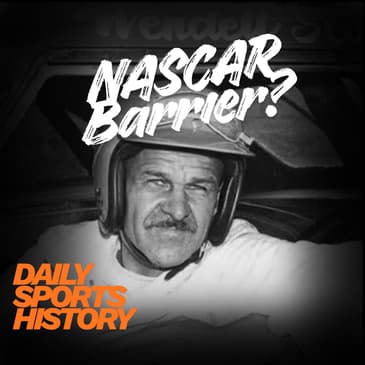
This episode dives deep into Scott’s journey from the dirt tracks of the segregated South—where he ran moonshine and built his own cars—to the very top of NASCAR.
Discover how he outlasted discrimination, sabotage, and chronic underfunding, built a family-run team, and toppled the barriers that shaped both his life and the sport. Learn how the Scott family spent decades fighting for proper recognition of Wendell’s Jacksonville triumph and why, nearly 60 years later, NASCAR finally presented them with the trophy.
Perfect for fans of sports history, racing culture, civil rights, and underdog legends, this episode captures the drama, injustice, and inspiration behind one of the most important moments in motorsports history. Dive in to understand what it meant to be the first—and why Wendell Scott’s story still matters today.
#WendellScott #NASCAR #NASCARHistory #SportsHistory #RacingHistory #Jacksonville200 #CivilRights #Trailblazer #Motorsports #UnderdogStory #FirstBlackWinner #StockCarRacing #SportsPodcast #StorytellingPodcast #InspiringStories
Buy me a coffee: buymeacoffee.com/dailysportz
Newsletter: https://substack.com/@dailysportshistory?r=3en496&utm_medium=ios&utm_source=stories&shareImageVariant=light
DailySportsHistory.com
Email: dailysportshistory@gmail.com
YouTube: YouTube.com/@dailysportshistory
Twitter: twitter.com/dailysportshis
Facebook: facebook.com/profile.php?id=61551687917253&mibextid=ZbWKwL
On December one, nineteen sixty three, bought the Jacksonville two hundred. Windel Scott crossed the finish line two laps before anyone else, although no one knew it at the time, he had won the race and be hours before he would get recognized and get his prize money as the first African American to win a NASCAR race, causing controversy in NASCAR and breaking down barriers for the racing community as a whole. He was truly a man respected by all other drivers for his drive and his grip in the face of adversity. Join us today as we dive into Windel Scott and how he won his NASCAR race today on Daily Sports History. Welcome to Daily Sports History. I mean than Red's to your host, because I once to run a race on a big wheel. So who he was? Wendell Scott. He was born back in nineteen twenty one in the middle of a town with cotton mills and tobacco factories and under the restrictions of segregation. And his father was a chauffeur in an auto mechanic and this is what led to Windell learning the skills that would define his life as a boy he always raced his bicycles and loved to go fast, and he actually ended up dropping out of high school to work as a taxi driver to help Macon's meet and would join the army as a mechanic during World War II, learning even more about his craft. Now after the war, he would return back to his hometown where he opened a small auto shop and continued his taxi work to support his growing family, as he would go on to have seven kids seven and like many Southern communities, he also occasionally ran a little moonshine and built up a reputation for his speed and being able to use his mechanic knowledge to help get an advantage. And in nineteen fifty two, a local promoter saw a black driver to draw more African American fans to the local dirt track for a race. He came across Windell who agreed, and it was his first organized stock car race and he drove a borrowed car and immediately showed promise as he finished third in the race, earning fifty dollars and he was later Scott would say, once he found out what it was like to race, it's all he wanted to do as long as he can make a decent living. He didn't want to do anything else, but the problem was the best way to make a living racing cars at the time was a company called NASCAR, who was started by moonshiners just like Scott, but they were white, which was a big deal back the time. So Scott actually turned to a Dixie circuit, which was more independent tracks and often featured racers or other people that were barred from the mainstream races. And he was able to get his first win doing this down at Lynchburg, Virginia, and it kept him motivated, and in nineteen fifty nine he really showed what he was worth, winning twenty two featured races, including the Richmond Track Championship and the Virginia State Fair Sportsman title, and it gave him a chance to join NASCAR. So after having some success in the Dixie circuit, he tried to enter a NASCAR sanctioned event, and his initial attempts were met with just outright racial exclusion. He was denied entry to races at Winston Salem in North Carolina and solely based off his race, not his racing, and so he continued to try as much as he could to enter these NASCAR races, and he went to Richmond Speedway and approached a NASCAR stewart, Mike Poston, who was a local official with the authority to issue NASCAR licenses, and Poston knew of Scott's talent and that he never gave up, so they gave him a license. This would allow him to compete in NASCAR races. But despite having his license, it would be a while before he could get a chance to actually race, as the racing world was in the South, and the South still at the time was very segregated and not open to all races. But he was able to make his debut in nineteen sixty one at NASCAR's Grand National in Spartanburg, South Carolina, where there was eighteen racers and he finished seventeenth, not a strong start, but it was significant as he was the first black driver to compete in a NASCAR race, breaking down barriers and just showed his resiliency. Now, part of the reason why he finished seventeenth was he was operating on a shoestring budget, driving used cars, preparing every part himself, and not having a whole lot of sponsorships because he was a black driver and most of the sponsors were white owned businesses, and even though he was able to race in that race, it didn't mean that every race track would allow him to race. He would get barred from multiple tracks such as Darlington for several years Dover who were just fought out denying him based off his race, but it didn't deter him. And it was a family affair where his wife would actually drive the truck hauling the cars to the racetrack and their seven kids were his pit crew for most of his races. The Scott family was a unit and without them, Wendell Scott wouldn't have had the success he did. But what really helped is his resiliency showed how good he was as a driver and caught the eye of Hall of famers Richard Petty and Ned Jarrett, who were also from families of racers, and they really helped him along his way to help whenever he hit a barrier, to help knock that down for him to have success on the track, as in nineteen sixty four, Ned Jarrett helped Scott to get a competitive car, which was a Holman Moody forward that could actually compete with the newer cars that he was facing off against and this allowed him to actually finish twelfth in points that year, despite missing several races due to racism. By the mid nineteen sixties, Scott was consistently finishing in the top ten in points every season, and his career best was in nineteen sixty six where he finished sixth overall, finishing above Hall of Fame racers. He was a true professional, never getting into racial argument or fights, just turning the other shoulder. But in nineteen sixty three at the Jacksonville two hundred was something different. The race was at the Grand National Race at the Speedway Park in Jacksonville, Florida. It was half a mile track where they ran two hundred laps equaling one hundred miles, and the track was challenging as it was a dirt oval, which made it tricky and it caused frequent mechanical failures. Richard Petty, one of the greatest racers of all time, would go on to lead the most laps, but would have steering issues that kept him out twenty five laps before the end. But this issue in Petty's car allowed Scott to seize the lead and pull ahead, eventually finishing two laps ahead of all the other competitors, crossing the finish line with two hundred and two laps, two laps more than second place Buck Baker. Now, despite crossing first, Scott never actually saw a checkered flag wave for him. Instead, Buck Baker was declared the winner on the spot and celebrated in victory lane, receiving the trophy. Now, the confusion was because it's hard to keep track manually of how many laps somebody runs in a race. Thank goodness for electronics. I couldn't imagine doing it today. So what happened was there was an air in the manual scoring system, which tracks how many laps each driver has done, and the race of officials admitted the scoreboard was missing two laps that Scott had ran, contributing to the error. It took two hours before officials actually admitted the mistake, and spectators, the Beauty Queen, and even Buck Baker had already left the venue, leaving the declaration unheard of and unnoticed. NASCAR officially awarded Scott the win and the prize money, but the lack of any presentation of the winner circle really made it seem like they were trying to hide that he actually won causing even more controversy, and Scott actually never actually received a trophy, and it wasn't until two thousand and one, long after his death, that the family actually received a ceremonial trophy. So after receiving the prize money, which was a one thousand dollars back then, which would be a little over ten thousand dollars to day, which is pretty good for one day's work now, this would be Scott's only career win, although he continued to raise for over a decade in NASCAR in nearly five hundred races, earning respect all around the NASCAR community, and he would have over one hundred and forty seven top ten finishes, and it wouldn't be till two thousand and one till another black man would win a NASCAR with Bubba Wallas and sadly, he would pass away at the age of sixty nine in nineteen ninety and would be ducted in twenty fifteen into the NASCAR Hall of Fame as a pioneer for diversity and inclusion into the sport. As he did all this during a time when America was going through civil rights and racial issues throughout the country. He made a breakthrough in arguably one of the whitest sport the time, and in nineteen seventy seven they actually made a movie about his life starring Richard Pryor and Wendell Scott. Did so much for his community in the NASCAR world breaking down these barriers. Although there have not been many African American drivers since, it just shows you that the barrier of NASCAR is huge, as without money, it's very hard to get into the sport, but he was able to do so and if you have to drive, you can do anything. I want to thank you for listening to today's Daily Sports History. If you like this, please share it with the friends say do you even know about this guy? And come back tomorrow for more Daily Sports History.