Buy me a coffee: buymeacoffee.com/dailysportz
Newsletter: https://substack.com/@dailysportshistory?r=3en496&utm_medium=ios&utm_source=stories&shareImageVariant=light
DailySportsHistory.com
Email: dailysportshistory@gmail.com
YouTube: YouTube.com/@dailysportshistory
Twitter: twitter.com/dailysportshis
Facebook: facebook.com/profile.php?id=61551687917253&mibextid=ZbWKwL
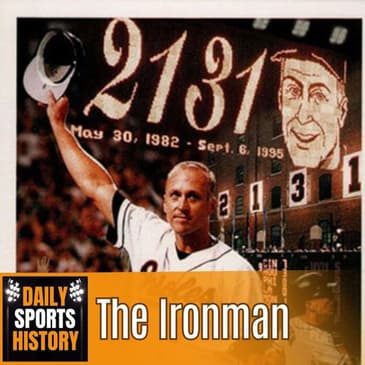
On September 6th, 1995, Cal Ripken does something that many thought would never happen and what is one of the most challenging records to beat, the Ironman record, becoming baseball's Ironman, beating Lou Gehrig for the most games played in a row. But he was more than just a player that played a long time, just like Lou Gehrig was. He was a Hall of Fame player as well. and a Baltimore Orioles icon. Today we're going to dive into Cal Ripken and how he became the Ironman of baseball. Today on Daily Sports History. Welcome to Daily Sports History. I'm Ethan Reese, your guide to a rapid deep dive into sports history every day. And today's trivia question to listen out for is, how did Cal Ripken injure his knee that jeopardized his streak? Now, Cal Ripken was born in Maryland in 1960. And at the time, his dad, Cal Ripken Sr., was a coach for the Baltimore Orioles, foreshadowing what would become of Cal Ripken Jr. 's life. As his dad was a coach of baseball, he grew up around baseball and loved it. Him and his brother, Billy, actually were both on the Aberdeen High School baseball team and made one of the best high school teams. As Cal Ripken Jr. grew up to be 6'5 and became a five-tool player and actually had success in high school as a pitcher. But when he wasn't pitching, he was playing shortstop and led his team to a state championship where he pitched a complete game to win the state title. And the Baltimore Orioles drafted Ripken in the second round of the 1978 draft and number 48 overall. And he made the decision to go straight from high school to the pros because after talking with his family, he knew he wanted to play baseball for a career, but if it didn't work out, college would always be there later in life. Now he was drafted both as a pitcher and a shortstop, but the Oilers didn't see him as a professional pitcher and focused more on him being a shortstop in the minor leagues as he was also a great hitter and would quickly move up through the ranks in the minor league system. And on August 10th, 1981, would play his very first game for the Baltimore Orioles. And he did so as a pitch runner. Now, he struggled his first year, batting only 182. But the next year, he would make the transition to third base and would start a streak on May 30th that would lead him to be an Ironman. And later on that season, he would get moved to shortstop, where he would play most of his career. And it wasn't long before... he became a success in the major leagues. As in the 1983 season, he was an all-star and became the AL MVP, hitting. 318 with 27 homers in just his second season after being named Rookie of the Year. And that same year, he would lead the Orioles to win the World Series in his only World Series title in just his second season. So all by the age of 25, he had been named an MVP and won a World Series championship. and started a streak, which would make him an icon in baseball. And he would continue his luck, as before the 1984 season, he signed a four-year contract worth almost about a million dollars a year. In that season, he would hit over 300 again with 27 home runs. And just before the 1987 season, Cal Ripken Sr. would be named manager of the Orioles, becoming the first manager to manage two sons on the team, as Cal's brother, Billy Ripken joined the majors that year as well. Now, during this time, while his dad was the coach, the Orioles didn't have a whole lot of success on the field. And by 1993, it would be the first time that his dad wouldn't also be part of the team, as he would be let go after the 1992 season. And this was the year that his streak was in question, as on June 6th, he injured his knee during a brawl against the Seattle Mariners, and he didn't think he'd be able to play the next day, but woke up feeling fine and continued his streak. And on August 1st, 1994, he played in his 2,000th consecutive game versus the Minnesota Twins. And this is when the league started to count down. Was he ever going to catch Garrick? Whose record had stood for over 50 years. And within two years, he would go on to pass Luke Garrick. On September 6th, 1995, was one of the most watched games in ESPN history, as everyone wanted to see Cal Ripken pass Luke Garrick. In the game versus the Los Angeles Angels, Cal had all his family there. The president, Bill Clinton, and vice president, Al Gore, were at the game. And after the fifth inning, everyone started to cheer. Because when the fifth inning happened, it meant the game was official. And Cal Ripken... had broken the record. And the Orioles honored Lou Gehrig by selling special box seats, giving the proceeds to John Hopkins University to study Lou Gehrig's disease. And for 22 minutes, the game was stopped, giving Ripken a standing ovation. As you can see, a memorable sign out of the right field of 2-1-3-1, showing that he had broken the record. It was a great moment for baseball, helped raise the awareness. It was one of the most viewed games. And it kind of harkened back to Lou Gehrig and helped grow ALS research and made us think, what would it have been if Lou Gehrig did not get sick? And Rifkin gave a speech. Now, it's nowhere to the point iconic as Lou Gehrig's, but he said, Tonight, I stand here overwhelmed as my name is linked with the great and courageous Lou Gehrig. And just that first sentence there just shows his adoration for the game and what it meant that he broke this record. And he wasn't done playing. And as he continued to be successful and an all-star for multiple years, and then for the final five years of his career, he actually moved back to third base as he had lost a little bit of step with age, but allowed him to stay on the field and continue his great play. He would finally finish his career being a 19-time all-star. Winning the World Series in 1983. A two-time AL MVP in 1983 and 1991. And was a silver slugger, meaning he was the best hitter for his position eight times. And would finish his career with 2,632 consecutive games. And he played his entire career with Baltimore. Where they would retire his number eight jersey and would be inducted into the Baseball Hall of Fame in 2008. and 7 and be part of the Major League Baseball All Sensory Team. So just like Lou Gehrig, he wasn't just a player that played a lot. We covered... the NBA Ironman, A.C. Green, who was a role journey player throughout his career. But Cal Ripken was anything but that, as he was one of the best players to ever play the game and will be forever known as baseball's Ironman, as his record will probably never be broken in the way the game is played today. I want to thank you for listening to today's Daily Sports History. It means a lot to me. If you want to reach out to us, if you have a topic you want us to cover, you can do that at dailysportshistory.com and you can send us an email or leave us a voicemail. We'd love to hear from you and maybe include your information on the show. And did you catch the answer to today's trivia question? How did Cal Ripken injure his knee that jeopardized his streak? And the answer is... He was in a dugout clearing brawl with the Seattle Mariners and bruised his knee, but luckily it healed for him to continue his streak.