Buy me a coffee: buymeacoffee.com/dailysportz
Newsletter: https://substack.com/@dailysportshistory?r=3en496&utm_medium=ios&utm_source=stories&shareImageVariant=light
DailySportsHistory.com
Email: dailysportshistory@gmail.com
YouTube: YouTube.com/@dailysportshistory
Twitter: twitter.com/dailysportshis
Facebook: facebook.com/profile.php?id=61551687917253&mibextid=ZbWKwL
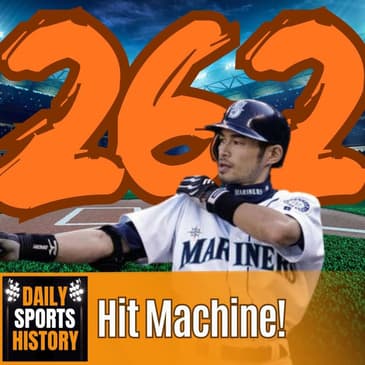
In 2004, Ichiro Suzuki wrote the history book. He took a season where his team struggled to win games and made it remarkable, breaking a record that had stood since 1920, the single season hit mark, and would stretch it to 262 hits. in a single season, showcasing his unique skill in raw speed, being a complete player that would be a dream in today's baseball. And when he finally broke George Sissler's legendary record, the baseball world stood in awe as he was breaking barriers, allowing Japanese players to play in Major League Baseball. Join us today as we dive into this historic season and what made Ytrio a legend on daily sports history. Welcome to Daily Sports History, I'm Ethan Rees, your guide, because I can quote every line from the movie Sandlot. And today's trivia question to listen out for, how long was the hit streak did George Seisler have during his historic 1920 season? So to start, Ichiro was born in Kugai, Japan, and with the help of his family, he quickly picked up baseball. His father played a pivotal role overseeing his training sessions for hours as he grew to love the game more and more. And his reputation as a schoolboy prodigy, despite his small size, which he only grew to be about 5'9, 130 pounds when he was in Japan. But even with his small size, he showed a unique skill for getting on base and getting base hits. And this allowed him to get drafted in the fourth round of the Nippon Professional Baseball League, which is the highest league In Japan, whenever a player comes over to play in the Major League Baseball from Japan, they come from this league. And it's really the second best league in the entire world. And he was drafted by the Oryx Blue Wave in 1992, right out of high school. But he spent the first couple seasons in Minor League Baseball because of his small size and his unconventional style. batting motion. Now, if you've not ever seen Ichiro's swing, it's a swing where he does a big leg kick, which is a very common swing in Japan. It's something they actually teach a lot. Then he moves his body forward as the ball is coming, like almost in a starting running position. So it's a very hard thing to replicate because you have to not only be moving, but move and swing the bat with a ball coming at you maybe 100 miles an hour. Very difficult skill to learn, but he perfected it over time. Now, this pendulum swing wasn't an uncommon swing in the Nippon Baseball League. People had done it before to try to get an advantage, especially left-handed hitters as they were closer to first base. If they could get a quick hit and be already running to first, it gave them an extra step. But it's frowned upon here. We want home runs. We want big hits. We want solid contact. But... Nowadays, we just want to get on base. That leads to runs. But after a couple years in the minors, he joined the pro team where he had a batting average of 385 and set a Japanese record with 210 hits in just 130 games. And he would go on to win seven consecutive batting titles for the Pacific League and posted a career batting average of 353, collecting over 1,200 hits in just a seven-year span. He would win three consecutive MVPs from 1994 to 1996 and became known as the Hit Manufacturing Machine. Japan, I'm sorry, work on your nicknames. That's a terrible nickname. But after the 2000 season, the Nippon League had joined with Major League Baseball to develop a posting system. See, prior to this, Japanese players didn't go play Major League Baseball. So we probably missed out on many, many, many, many great baseball players. As we know now, seeing Sheihai Otani just breaking down barriers in baseball of what he can do, we missed probably a lot of other players that could have really done something special. But this system was put into place. kind of start having a chance for these players to join Major League Baseball. The problem was this gave financial compensation to the Japanese teams for losing this great player, but it also meant that Major League Baseball was paying extra money just to pay these players extra money. It was a crazy system that was a sealed bidding system where you would bid for just the right to negotiate with the player. So a lot of teams, especially to start with in this system, did not want to participate because it was a lot of money. And there was no track record of a player coming over as a position player and having success in the major leagues. So it was a huge gamble. Some teams were willing to pay that gamble. And the Mariners beat out the Mets, the Dodgers, the Angels, and the Red Sox for the chance to bid for the right to Ituro. And they bid over $ 13 million just to bid for the rights. And they would end up giving him a three-year, $ 14 million contract. So add that up, they're paying $ 27 million for Ichiro, if you total it in three years. The reason was, was the owners of the Seattle Mariners was Hiroshi Miyamachi, and he was the president of Nintendo, which is the biggest gaming system in Japan, and a huge company there. So he already knew how good Ichiro was, and knew it was worth paying that extra money. So they had Ichiro, a little bit behind the curtain, and someone nudging them to want to have him in Seattle. So Ichiro became the first position player in Major League Baseball history. There's also Marakami, who played for the Giants in 1964. He was a pitcher, and he was just okay. And then you had Hideo Nomo, who started pitching in 1995, and he was pretty good. So we've only had pitchers. This was the first positional player, and it wasn't a guy you looked at and thought, oh, look, he's going to have so much power. He's going to change the game. Because at this time, it was all about power. We had just had multiple seasons from Mark McGuire and Sammy Sosa breaking home run records. And not far behind them was Barry Bonds. So this was the power steroids era. And Ichiro Suzuki was not that at all. Just the exact opposite. But that didn't mean he wasn't going to have success. And he came in with a bang. Hitting 242 hits in his very first season. Led Major League Baseball. in multiple categories in hits, batting average with. 350, and stolen bases with. 56. And he would be named Rookie of the Year in the American League. And the MVP of the American League. It just showed how good... And how great he was when he came over. It was just surprising for everyone that didn't think Japan had a good baseball program. So he came out of the gate swinging. And he continued to have success after success. After the 2001 season, he had more success. And then he was a perennial all-star. One of the best players in the league coming into the 2004 campaign. So the team came in, and they weren't expected to do a lot, but they finished second in the division the year before, winning 93 games. And they hadn't made a whole lot of changes, so they thought maybe there was a good chance they would be able to build on the success and have another good campaign. Fortunately, that is not what happened. The team just kept losing, and Ichiro also struggled at the very beginning of the season, hitting just 26 hits in April. With a batting average of. 255. This is a guy that regularly had a batting average over. 325. One of the most consistent hitters. But he was struggling. So he took it upon himself. Used all the things he could. Focused. Watched more film. Focused on defensive shifts that were coming his way. Seeing how he could alleviate this. Then come May, he exploded. This broke his slump. he hit 50 hits in May. July, he hit 51. In August, he hit 56 hits with a batting average of 463. The best monthly performance in Major League Baseball history. And in September, he would again hit more than 50 hits, becoming the first player in the modern era to have four 50-hit months in one season. Showing that it wasn't just A few games here and there. From May 1st. Till September 9th. He hit. Over. 400. Which put him in rarefied air. That season. He had. More than 80. Multi-hit games. And most of his hits. Were singles. He really perfected. That pendulum swing. And getting on base. He would go on to hit. 262 hits. This season. Breaking a record that stood. Since 1920. In. 225 of those were singles. And he ended the season with a batting average of 372. But he wasn't just doing it at the plate. That season, he added another gold glove to his collection and finished second in the American League in stolen bases with 36. He was the epitome of the small ball or the money ball technique that became very popular around this time. And he was the perfect gym for the next-gen stats era. So the season is going great for Ichiro after his slow start. And when October 1st comes, Ichiro stepped up to play to break George Sisler's single season record. The crowd is packed, creating a night of drama. He's two hits behind to break the record. And George, his record is memorable in and of itself. He hit 257 hits in a season with just 154 games. That's eight less than Ichiro would play. And that included a month of June where he had 60 hits and had a 41-game hit streak during that year. He was also voted AL MVP. But now, in 2004, each row had him in his sights. Coming into the game, he had 256 hits, one shy of Sisler's record. So coming into the game, facing off against the Texas Rangers at Safeco Field, the fans were ready to see what would happen. In the first inning, he is the leadoff hitter, facing Ryan Sissler. Dries, he takes a strike, fouls off two pitches, then he singles to left, tying Sisler's record. The crowd erupts. They were just excited to see him tie it. But then in the third inning, he comes back up to the plate. And with a 3-2 count, he singles right up the middle in a patented Ichiro style. Makes it to first, breaking the record, becoming the all-time hitter in regular season history. Fireworks explode from the stadium. The crowd gives a standing ovation. The team rushes to greet Ichiro. He gives a reluctant smile as he doesn't love the spotlight, but feels the enormous weight lifted, and he describes it as the best moment in his baseball career. Immediately after, he shook the hand of George Sisler's daughter, Frances, who later expressed that her father would have been happy to know such a great player and man would break his record. And Ishiro's father, who was in Japan watching the game, was brought to tears, celebrating everything that was happening for his son in Seattle. Now, the season wasn't over. He would go on to add four more hits, bringing him to a total of 262 hits that year. That was 46 more than the runner-up, and he received tributes from legends in the baseball world, and even from his home country of Japan. Major League Baseball honored Ichiro with a replica bat modeled after his sisters, commemorating this. And you could say this may have been the peak of Ichiro's career. He would not break his record, but would continue to maintain having 10 consecutive seasons with over 200 hits, the only player to ever do so, and no one has ever come close to breaking his record and probably never will. To do so, you have to hit at least one hit in every single game, meaning you do not get injured and you are always playing. It's something that does not happen in today's sports. He would also go on to accumulate over 3,089 hits in the major leagues. Adding that to his Japanese total, it makes him the most prolific hitter of all time with a total of 4,000 367 hits, which tops Pete Rose. And he would also be the first Asian-born player inducted into the National Baseball Hall of Fame, breaking down multiple barriers for multiple players from Japan to come over here. And the Seattle Mariners had went on to retire his number 51. And interestingly enough, they actually retired two number 51s, as Randy Johnson also wore 51 for the Mariners in the 90s. one of the greatest pitchers of all time. So they have two 51s, but they didn't retire them on the same day because Randy wanted Ichiro to have his moment on his own. Now Ichiro is a special assistant with the Mariners and a chairman with the team, behind the scenes mentoring the next generation and always being a guide and a role model for everyone in the world, as baseball is now a world game thanks to Ichiro. I want to thank you for listening to Daily Sports History, and I want to let you know that I'm going to be doing some things a little differently. I'm going to try some different things to the show, maybe do different sound effects or different segments, or I'm not sure exactly, but I hope you stick around. And if you have ideas for the show or some comments you want to leave me, send it to dailysportshistory at gmail.com. I will reply to you for sure. Give me all the feedback you can because the feedback you give me, I take to heart. And we will work on this, making this the best show possible. And we'll see you on the next one. And did you catch the answer to today's trivia question? How long was the hit streak that George Seisler had during his incredible career? 1920 season and the answer was 41 games. One of the highest hit streaks ever in MLB history.