Buy me a coffee: buymeacoffee.com/dailysportz
Newsletter: https://substack.com/@dailysportshistory?r=3en496&utm_medium=ios&utm_source=stories&shareImageVariant=light
DailySportsHistory.com
Email: dailysportshistory@gmail.com
YouTube: YouTube.com/@dailysportshistory
Twitter: twitter.com/dailysportshis
Facebook: facebook.com/profile.php?id=61551687917253&mibextid=ZbWKwL
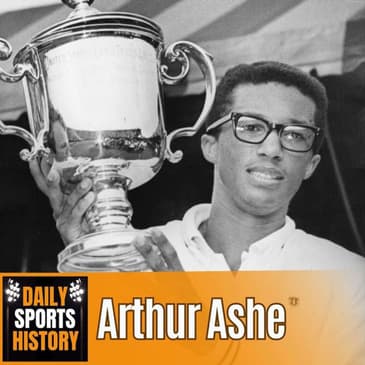
On September 9th, 1968, was an unforgettable day in tennis and was a historic day for the fight of equality in sports. When amateur tennis player Arthur Ashe went from unknown to winning the U.S. Open, becoming the first black man to win a Grand Slam title. But Arthur was not just a one and done. He went on to do so many things on and off the court, being an inspiration to this day. And today we're going to dive into how it all began on Daily Sports History. Welcome to Daily Sports History. I'm Ethan Reese, your guide to help you learn more about sports history as you become more of a sports expert. And today's trivia question is, what is the only Grand Slam that Arthur Ashe did not win? Now, Arthur Ashe was born in the 1940s in Richmond, Virginia, which at the time was involved in all the Jim Crow laws. So separate but equal was in effect. And that actually shaped how he grew up. His mother, at the age of six, his mother passed away due to complications to childbirth. At only the age of 27, him and his brother were left to be raised by his father. And his father ended up being the caretaker of the Brookfield Park, an 18-acre black-only park, the largest in the Richmond area. And this shaped Arthur Ashe. As he was a skinny kid, and his father didn't want him to be playing football as many other kids did, as he didn't want him to get hurt. But growing up in this park, They had playgrounds, basketball courts, a pool, baseball, and four tennis courts. And at the age of seven, he began to pick up the game, the sport, which is something at the time was very uncommon in the black community as tennis was viewed as a mainly white sport. And there was actually a lot of segregation in the sport and unintentional segregation as they wouldn't put tennis courts in inner cities or in black communities. They were mainly white communities. So the black community was not given the opportunity to play tennis. Now that has changed a little bit. There's been a major push to it to where they are now at 11% of the tennis playing community is black. Still a small percentage, but it's a lot more than what it was in the 1960s, back when Arthur Ashe was growing up. But he had natural talent, and that was spotted by a Virginia Union University student, who was also a part-time tennis instructor, Ron Charity, who was one of the best black tennis players in the area. And he helped teach Arthur, so he got him in touch with Robert Walter Johnson, who was the coach of Aletha Gibson. who was the first black person to win a Grand Slam when she won the French Open in 1955. And Johnson also helped train Arthur Ashe and taught him the importance of racial socialization through sportsmanship and etiquette, which Arthur Ashe exemplified. He was also always even keel, always showed sportsmanship, was someone you always looked up to. That's how a player should be. And it all started growing up how he was taught. And after he was having challenges in high school, being able to play tennis, as he wasn't able to play against white youths in the area, and there was very limited courts and schools in the black community that had tennis, he moved to St. Louis his senior year to be able to compete more freely and to develop his game even more. And he became the first African American to win the National Junior Tennis title. And with his success, he was awarded a scholarship to UCLA in 1963 and becoming a member of the ROTC program, which required him to serve in the active military upon graduation in exchange for money for his tuition, as his tennis scholarship did not cover the entire tuition. And he went on to graduate with a degree in business administration and joined the U.S. Army in 1966, becoming a second lieutenant and was assigned to the U.S. Military Academy at West Point, where he worked as a data processor. And while he was there, he headed up the academy's tennis program and became a first lieutenant in 1968 and was honorably discharged in 1969. But what was happening for him on the court? In 1963, he became the first black player ever selected to the U.S. Davis Cup team. And while he was in college, he got ranked number three in the United States and won a national championship while in college for singles and doubles, while also helping UCLA win the team competition. Then in 1966 and 65, he was able to compete in the Australian championship. Now, at this time in tennis, it was known as the Open Era, which began in 1968, where all major tournaments, including Grand Slams, could include both amateurs and professionals competing against each other. Prior to this, only professional players could compete at these tournaments, which meant anyone in college could not attend. or in the Olympics wouldn't be able to participate in these as they would give up their amateur status to turn professional. And this really helped grow the sport as players could compete when they were younger and allowed tennis to grow as more competition produced better tennis. And this is how Arthur Ashe was able to participate in the US Open as he was still an amateur and wanted to keep his amateur status to compete on the Davis Cup team. But in order for him to even participate in this due to his military obligations, he had to make a deal with the U.S. military. To avoid being deployed to the Vietnam War during this time, his brother took his place to head to war so that Arthur could compete at the U.S. Open. So without the love and support of his family, this would have never happened. And entering the tournament, Arthur wasn't just a nobody, no one in the tennis community. In the world, many people didn't know who Arthur Ashe was, but in the tennis community, he was a fifth seed, so he wasn't a known name, but he was still an amateur. And in the first round, he won in straight sets. He moved on to the second round, where he again won in straight sets. And the third round was a tough match for him, facing off against Cliff Drysdale of South Africa in a five-set match where he won the final set, eking out a 7-5 final set victory. In the quarterfinals, he was able to win again in straight sets. Then the competition got even more heated as he got to the semifinals, facing off against Clark Garbner, who's a fellow American and amateur just like him. And the game went back and forth. Lasting 5 sets where Arthur was able to win the final 2 sets to make it to the finals of the US Open. Facing off against Tom Ocker who was a Dutch player. Who in 1974 he would go on to be the ranked number 3 overall in the world. Despite never winning a singles Grand Slam title. And this being his only US Open final. So just like Arthur he was determined to win. And the first set was incredibly tight as Ash took it 14-12. as both players held their serve and Ash broke through after extending the tiebreaker. But Ocker bounced back, winning the second set 7-5, as Arthur started to struggle, showing some unforced errors, allowing Ocker to capitalize. But being poised and determined, Arthur came back and regained control, winning 6-3 in the third set, playing more aggressive and showing his dominance. And in the fourth set, Ocker... wasn't going to let this die down as he won 6-3, forcing a decisive fifth set to decide it all. In the fifth set, he was able to keep his calm using a tactical approach, mixing in powerful serves as well as well-timed volleys to win 6-3, becoming the first African-American man to win a Grand Slam title and the first amateur to win as well. But like we said, he wanted to maintain his amateurism. So he did not accept the $ 14, 000 prize money. And it went to Ocker. Which is a nice consolation prize for losing to get the prize money. Which just shows the person he was. Now he wouldn't just compete. And he would go on to win the 1970 Australian Open and Wimbledon in 1975. As well as winning the Australian and French Open in doubles. But despite all his success, he was never actually ranked number one in the world. As he has other accomplishments and other duties as he became a civil rights activist. working with Dr. Martin Luther King on many different avenues, as well as becoming an HIV and AIDS activist. After in 1983, he had a heart bypass surgery and had a blood transfusion and contracted HIV. Now at the time, HIV was relatively new and many didn't know. Many thought you could only get it if you were a homosexual and that raised questions in his life. But he knew that wasn't the issue and he fought for the rest of his life. help raise awareness and funds for the research of HIV that's still going on to this day. Because of this diagnosis, it cut his legacy short as he was not able to continue playing. But in 1985, he was inducted into the Tennis Hall of Fame, and his legacy should never be forgotten. And ESPN and their ESPY awards hands out the Arthur Ashe Award for Courage every year to a person in sports that faces courage through adversity, just like Arthur Ashe did, not only dealing with the racism he had to deal with growing up and through all his tennis career, handling it with sportsmanship and etiquette. That award exemplifies everything Arthur Ashe stood for. But sadly, Arthur Ashe passed away in 1993. due to complications with HIV. But he should always be remembered for not only the great tennis player and the great barriers that he broke down, but who he was, exemplifying what sports is about. The love of the game. It's not about the money. It's about being the best person you can be. And I hope you enjoyed this episode. If you liked it, please leave us a review wherever you're listening. It really warrants my heart every time I see a rating or review. And bring a smile to my face. It only takes a little bit of time to do and come back tomorrow for more daily sports history and did you catch the answer to today's trivia question what is the only grand slam that arthur ash did not win the answer is the french open the farthest he made it in the french open was to the quarterfinals which he made in 1970 and 1971 Thank you.