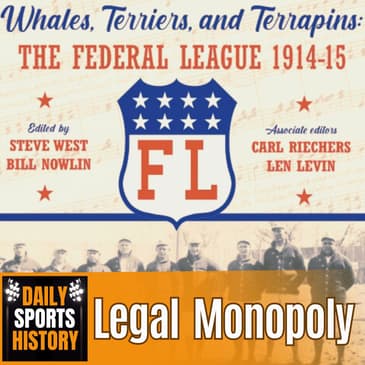
On this episode of Daily Sports History, we delve into the landmark 1922 Supreme Court decision that granted Major League Baseball an exemption from antitrust laws. Explore how this pivotal ruling shaped the business of baseball, its long-term impact on the sport, and the legal battles that defined America's pastime. Tune in for a fascinating look at a cornerstone moment in sports history.
#DailySportsHistory, #BaseballHistory, #1922SupremeCourt, #AntitrustDecision, #MLB, #SportsLaw, #HistoricRulings, #BaseballLegacy, #SportsPodcast, #LegalHistory
Buy me a coffee: buymeacoffee.com/dailysportz
Newsletter: https://substack.com/@dailysportshistory?r=3en496&utm_medium=ios&utm_source=stories&shareImageVariant=light
DailySportsHistory.com
Email: dailysportshistory@gmail.com
YouTube: YouTube.com/@dailysportshistory
Twitter: twitter.com/dailysportshis
Facebook: facebook.com/profile.php?id=61551687917253&mibextid=ZbWKwL
On May twenty ninth, nineteen twenty two, the US Supreme Court makes arguably the most important decision in baseball history when they vote to exempt baseball from the Sherman Anti Trust Act, which means they can act as monopoly and helps them grow bigger than ever before. Let's learn all about it today on Daily Sports History. Welcome to Daily Sports History. I'm Ethan Reese, your guide to a rapid deep dive into sports history every day. And today's trivia question to listen for is what important baseball historical figure was actually the original judge of the first monopoly lawsuit against organized baseball. Now, before we get going into the story, you have to understand that the American League and the National League were actually two separate leagues, but they did play each other for the World's Series at the time, so this was known as organized baseball. They are basically a partnership, but there was always the leagues. Starting up. In a nineteen fourteen one of the minor leagues for the National and American Leagues, known as the Federal League, declared itself a major league on part with both of them and started to try to sign multiple pro players. This was actually a good thing for the players as it raised their ability to get higher contracts because at the time, they had a clause in their contracts, meaning they could not go to other teams, so they had no negotiating power other than quitting baseball or getting paid whatever the team wanted. But if there was another league that wanted to pay them, they could leave, which helped raise multiple player salaries. Now the big name that the Federal League was able to sign was Walter Jones, who's second on the all time list for wins by a pitcher behind Cy Young, but he never played for the Federal League as as his team, the Washington Senators, countered and paid him enough for him to stay on their team. Now there were multiple teams that were in this Federal League. You had the Baltimore Terrapins, the Brooklyn Tiptops, the Buffalo Blues, the Cleveland Green Socks, the Covington Blue Socks, the Indianapolis Hoosiers, the Kansas City Packers, the new Ward Peppers, the Pittsburgh the Pittsburgh ReBs, and the Saint Louis Terriers. And in nineteen fourteen, the Indianapolis Hoosiers won their league championship and the following year, in nineteen fifteen, the Chicago Wales won the league championship. I wish some of these names were still around, such as the Tip Tops and the Peppers, but sadly they do not. In The Federal League actually started in nineteen thirteen across six cities in the Midwest, and they continued to grow, which was a great sign. In the next year, nineteen fourteen, they got to eight teams and declared themselves a major league, competing with the American and National League that we know today, and their president, James Gilmore, was fighting to make their league as popular and get as many fans as possible. They were selling their new league to the nation, and they wanted to attract well off owners that could afford the challenges of starting a new league, and they wanted to attract players from the American and National League. And they did actually have a lot of success, signing eighty one major league players and one hundred and forty minor league players, giving them all much higher salaries than they had before. But this was their ultimate downfall. Despite all this effort, in nineteen fifteen, they closed the league for good. But during all of this, organized baseball, which was the American and National League fought back, ferociously offering players more money to stay with them and even threatening players that if they signed with the Federal League they would not be allowed back into organized baseball and blackballing them. It would scare many players from taking the higher contracts. But the reason why the Federal League actually failed was because franchises were going bankrupt. They weren't attracting enough fans to pay these higher salaries that they were giving out to these players. Many of their salaries they were paying were higher than the established American and National Leagues, and many of the owners just couldn't hang on to continuously lose money to the hope that maybe they would one day get into the black. But interestingly enough, in nineteen fourteen, the Federal League, while they're challenging the National and American League, actually brought a lawsuit against them in Illinois. In the lawsuit, they named both the National and American League because at the time they were just two different leagues and not the Major League Baseball that we know today. And this also included all sixteen teams and their presidents, and they said that they were violating the Sherman Anti Trust Act. Which prohibits companies from being monopolies. Now, this is a unique case, as sports is a unique industry. They don't actually create anything. It's more of an entertainment type industry, so the monopolization is different. But they were doing monopolized tests such as intimidating players from signing against them. But the case landed on the doorstep of a familiar name if you're a baseball historian, Judge Kennesaw mountain Landis, who later became the commissioner of Major League Baseball and was always a fan of baseball. But he actually never ruled on this case as they kept pushing it back further and further, and the case got taken off his docket as many of the federal teams were starting to be bought out by Major League teams, buying their players back, buying their stadiums and things like that, and as most of the owners were going bankrupt, Organized Baseball paid over for one hundred and fifty thousand dollars to federal league owners, allowing them the chance to actually buy into Major League teams, which is really what they wanted to be part of, these big time baseball leagues. And you're like, how did this get to the Supreme Court. Well, the reason is not all of the federal teams wanted the buyout, and the Baltimore Terrapiants were not included in that buyout, so they filed their own lawsuit in Washington, DC, claiming that baseball was being a monopoly, and at first the state judge actually ruled in favor of the Baltimore Terrapians, saying that yes, Organized Baseball was acting as monopoly and gave them damages of eighty thousand dollars and also required them to pay for the Baltimore Terrapiants legal fees, which jumped up to a quarter of a million dollars in teen nineteen. But in December of nineteen twenty, after appeals by Organized Baseball, it was sent up to the US district courts, who reverse the verdict saying that the players, it is true, travel from place to place making interstate commerce, but they are not the game, basically saying that the US Court could not argue because it's not over interstate commerce, so it's not a federal case. But the Terrapins also appealed, which made it all the way the Supreme Court, which they all voted in a unanimous decision to uphold the appeals court decision in nineteen twenty two. Now, many people can argue the reason they gave was similar to the US Ditra Court. The games are interstate, but the players are not, and they're acting as a monopoly for the players and not the game. But many experts to this day still argue about this decision. Has it's still been upheld as it does affect interstate commerce, but no one has really brought it up again, and mainly because this allowed organized baseball to act even more of a monopoly and grow even bigger. Their salaries for their players continue to get bigger even because of the Federal League, because they needed to pay their players even more to keep them and have them not go. But as they continued to grow, they did not have any other issues. Now it's also been brought up that other major league sports in in the United States have also been brought up on this anti trust act, more famously being the USFL facing the NFL in the nineties. These sports leagues, the bigger they are, the more popular they are, the harder it is to take them down. They can act as a monopoly and frankly, some of US want them to act as a monopoly. The bigger they get, the more you get to watch, the more you get to love your team, the more you get stations like ESPN and Box Sports to cover sports, the more you can consume of sports because of the money deals they get. And it has grown the sports world from what it was back in the nineteen hundreds when players were making an average salary for a worker that makes it today roughly fifty thousand dollars. Now they're making roughly a few million dollars for the average player, and it makes it a huge difference that people want to be involved. And money is also attracted to this as everyone follows how much money they make. So acting as a monopoly can be a good thing, but it can also be sad to say, see the challenges grow, is it right? I don't know, but sometimes you got to challenge the big boys to see what might happen. Might you get burned? Yes, but if you don't try, you never know. And I want to thank you for listening to Today's Daily sports history. It means a lot that you took time to listen. And if you want me to cover a topic for you, please leave us a review wherever you're listening, put your name and the topic you want me to cover, and I be happy to do it for you, And come back tomorrow for more daily sports history. What important baseball historical figure was actually the original judge of the first monopoly lawsuit against organized baseball? Can a Stall Mountain landis